Air Combat Gunfighters Are Obsolete Again

Gunslingers in the 19th century. This is the Ned Christie posse.
Gunslingers or gunfighters (likewise called gunmen in the 19th and early 20th centuries) were individuals in the American One-time West who gained a reputation of being dangerous with a gun and participated in gunfights and shootouts. Today, the term "gunslinger" is more or less used to denote someone who is quick on the depict with a pistol, but can besides refer to riflemen and shotgun messengers. The gunfighter is also one of the almost popular characters in the Western genre and has appeared in associated films, video games, and literature.
The gunfighter could be a constable, outlaw, cowboy, or shooting exhibitionist, merely was more normally a hired gun who made a living with his weapons in the Old West.[1]
Origin of the term [edit]
The term "gun slinger" was used in the Western film Drag Harlan (1920).[ii] The word was soon adopted by other Western writers, such as Zane Grey, and became mutual usage. In his introduction to The Shootist (1976), author Glendon Swarthout says "gunslinger" and "gunfighter" are modern terms, and the more than accurate terms for the period would have been "gunman", "pistoleer", "shootist," or "bad human being" (sometimes written as "badman"). Swarthout seems to take been correct about "gunslinger", just the term "gunfighter" existed in several newspapers in the 1870s, and as such the term existed in the 19th century.[iii] Bat Masterson used the term "gunfighter" in the paper articles which he wrote most the lawmen and outlaws whom he had known. However, Joseph Rosa noted that, fifty-fifty though Masterson used the term "gunfighter", he "preferred the term 'mankiller'" when discussing these individuals.[4] Clay Allison (1841–1887), a notorious New Mexico and Texas gunman and cattleman, originated the term "shootist".[5]
Usage [edit]
Often, the term has been applied to men who would hire out for contract killings or at a ranch embroiled in a range war where they would earn "fighting wages".[3] Others, like Baton the Kid, were notorious bandits, and still others were lawmen similar Pat Garrett and Wyatt Earp. A gunfighter could exist an outlaw—a robber or murderer who took reward of the wilderness of the frontier to hide from genteel club and to brand periodic raids on information technology. The gunfighter could also be an agent of the state, archetypically a solitary avenger, simply more oftentimes a sheriff, whose duty was to face up the outlaw and bring him to justice or to personally administer it. There were as well a few historical cowboys who were actual gunfighters, such every bit the outlaw cowboy gang who participated in the encarmine Skeleton Coulee Massacre.[6]
Depiction in culture [edit]
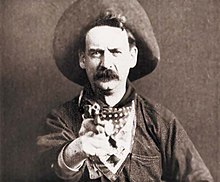
Gunslingers often announced equally stock characters in Western movies and novels, along with cowboys. Oft, the hero of a Western meets his contrary "double", a mirror of his own evil side that he has to destroy. [seven]
Western gunslinger heroes are portrayed every bit local lawmen or enforcement officers, ranchers, army officers, cowboys, territorial marshals, nomadic loners, or skilled fast-draw artists. They are normally masculine persons of integrity and principle – mettlesome, moral, tough, solid, and self-sufficient, maverick characters (frequently with trusty sidekicks), possessing an contained and honorable attitude (just often characterized as slow-talking).[8] They are depicted as similar to a knight-errant, wandering from place to place with no detail management, oftentimes facing curious and hostile enemies, while saving individuals or communities from those enemies in terms of chivalry. The Western hero usually stands alone and faces danger on his own, commonly against lawlessness, with an adept display of his concrete skills (roping, gun-play, horse-treatment, pioneering abilities, etc.).[seven]
In films, the gunslinger often possesses a nigh superhuman speed and skill with the revolver. Twirling pistols, lightning draws, and trick shots are standard fare for the gunmen of the big screen.[1] In the existent world, however, gunmen who relied on flashy tricks and theatrics died chop-chop, and well-nigh gunslingers took a much more than practical arroyo to their weapons. Real gunslingers did not shoot to disarm or to print, just to kill.[1]
Another classic bit of cinema that is largely a myth is the showdown at high apex, where two well-matched gunslingers agree to run into for a climactic formal duel. These duels did occasionally happen, as in the case of the Luke Short – Jim Courtright duel, just gunfights were typically more spontaneous, a fight that turned deadly when ane side reached for a weapon, and no one knew who actually won the fight for several minutes until the air finally cleared of fume.[9] Gunfights could be won past unproblematic distraction, or pistols could be emptied as gunmen fought from behind cover without injury. When a gunman did square off, it rarely was with some other gunfighter. Gunslingers normally gave each other a wide berth, and it was uncommon for two well-known gunslingers to face off.[1] The gunslinger'southward reputation often was as valuable as any skills possessed. In Western films and books, young toughs frequently challenge experienced gunmen with the hopes of edifice a reputation, only this rarely happened in real life. A strong reputation was enough to keep others civil and often would spare a gunfighter from disharmonize. Even other gunslingers were likely to avoid any unnecessary confrontation.[ane]
In the days of the Old West, tales tended to abound with repeated telling, and a single fight might grow into a career-making reputation.[1] [ten] For instance, the Gunfight at the O.K. Corral fabricated legends of Wyatt Earp and the Outlaw Cowboy gang, but they were relatively minor figures before that conflict. Some gunslingers, such equally Bat Masterson, actively engaged in self-promotion. Johnny Ringo built a reputation as a gunslinger while never taking office in a gunfight or killing unarmed civilians.[ commendation needed ]
Fact and fiction [edit]

Gunfighters fighting off an Indian set on
Most gunfights are portrayed in films or books every bit having 2 men foursquare off, waiting for i to brand the showtime move. This was rarely the case. Oftentimes, a gunfight was spur-of-the-moment, with one cartoon his pistol, and the other reacting. Oftentimes information technology would develop into a shootout where both men bolted for cover.[11] In pop folklore, men who held noteworthy reputations as a gunfighter were eager to match up against another gunman with the same reputation. On the contrary, in cases where two men held a like reputation, both would avoid confrontation with one another whenever possible.[1] They rarely took undue risks, and usually weighed their options before confronting another well-known gunman. This respect for 1 another is why well-nigh famous gunfights were rarely two or more than well-known gunmen matched up against i some other, only rather ane notable gunman against a bottom-known opponent or opponents.[ commendation needed ]
These fights were unremarkably shut-up and personal, with a number of shots blasted from pistols, oftentimes resulting in innocent bystanders hit past bullets gone wild. Much of the time, it would be difficult to tell who had "won" the gunfight for several minutes, as the black pulverisation fume from the pistols cleared the air.[ten] How famous gunfighters died is as varied as each man. Many well-known gunfighters were and then feared by the public considering of their reputation that when they were killed, they died as a event of ambush rather than going down in a "blaze of glory".[12] Others died secluded deaths either from old historic period or illness.[ citation needed ]
Mythology and folklore frequently exaggerate the skills of famous gunfighters. About of these historical figures were not known to be capable of trick shooting, nor did they necessarily accept a reputation for precision sharpshooting. Such tropes that are frequently seen in Westerns include shooting the center of a coin, stylistic pistol twirling, glancing shots that intentionally only graze an opponent (the bullet through the hat beingness an example), shooting an opponent'south belt buckle (thus dropping his pants), a bullet cutting the hangman's rope, or shooting the guns out of opponents' hands (typically equally an alternative to killing). The last was debunked by Mythbusters as an impossibility, as unjacketed bullets tend to shatter into fragments that can hurt or even impale.[13] Ed McGivern dispelled the myth of the inaccuracy of pistol fanning past shooting tight groups while fanning the revolver.[fourteen]
In Western movies, the characters' gun belts are often worn low on the hip and outer thigh, with the holster cutting abroad around the pistol's trigger and grip for a smooth, fast draw. This type of holster is a Hollywood anachronism.[15] Fast-draw artists can be distinguished from other pic cowboys considering their guns will often be tied to their thigh. Long before holsters were steel-lined, they were soft and supple for comfortable all-twenty-four hours clothing. A gunfighter would use necktie-downs to keep his pistol from catching on the holster while cartoon. Most of the fourth dimension, gunfighters would just hibernate their pistols in their pockets and waistbands.[9] Wild Nib Hickok popularized the butt-frontwards holster type, which worked better on horseback.[fifteen] Other gunfighters would use bridgeport rigs that gave a faster and easier draw.[16] Revolvers were a pop weapon to gunfighters who were horsemen, cowboys, and lawmen because of their concealability and effectiveness on horseback.[1] The Winchester rifle was as well a popular weapon amid gunfighters. Dubbed the "Gun that Won the Due west", it was widely used during the settlement of the American frontier. Shotguns were also a pop weapon for "express messengers" and guards, especially those on stagecoaches and trains who were in charge of overseeing and guarding a valuable private shipment.[ citation needed ]
Quick depict and hip shooting was a rare skill in the W,[17] and only a handful of historically known gunslingers were known to be fast, such as Luke Short, John Wesley Hardin, and Wild Bill Hickok.[9] [15] Shooting a pistol with one paw is commonly associated with gunslingers,[18] and is as well a standard for them of the era to carry ii guns and fire ambidextrously. Capt. Jonathan R. Davis carried two revolvers in his iconic gunfight,[19] while Jesse James himself carried over half a dozen revolvers in many of his gunfights.[20]
Gunfighters King Fisher, John Wesley Hardin, Ben Thompson, Billy the Child, Wild Nib Hickok and Pat Garrett all died as a result of ambush, killed past men who feared them because of their reputation.[10] Gunmen Child Curry, Jim Courtright, Dallas Stoudenmire and Dave Rudabaugh were killed in raging gun battles, much every bit portrayed in films nigh the era, and usually confronting more than 1 opponent. Bill Longley and Tom Horn were executed. Famed gunman Clay Allison died in a wagon accident. Gunmen Wyatt Earp, Bat Masterson, Bass Reeves, Commodore Perry Owens, and Luke Short all died of natural causes, living out their lives on reputation and avoiding conflict in secluded retirement. Gunfighter and lawman Frank Eaton, known as "Pistol Pete" lived into quondam age and gained further fame, before his death at historic period 97, by becoming the mascot for Oklahoma A&M College (now Oklahoma Land University). Rare are the gunfighters who, like William Sidney "Cap" Light, died accidentally past their own hand.[10]
Famous gunfights [edit]
The near important lesson I learned ... was that the winner of a gunplay unremarkably was the ane who took his time. The 2d was that, if I hoped to live on the borderland, I would shun flashy trick-shooting—grandstand play—as I would poison ... In all my life as a frontier peace officer, I did not know a really skilful gunfighter who had anything only contempt for the gun-fanner, or the human being who literally shot from the hip...[15]
– Wyatt Earp
The image of a Wild Westward filled with countless gunfights was a myth generated primarily by dime-novel authors in the late 19th century. An estimate of 20,000 men in the American W were killed by gunshot betwixt 1866 and 1900,[21] and over 21,586 total casualties during the American Indian Wars from 1850 to 1890.[22] The most notable and well-known took place in the states/territories of Arizona, New United mexican states, Kansas, Oklahoma, and Texas.[23] Actual gunfights in the Onetime W were very rare, very few and far between, but when gunfights did occur, the cause for each varied.[9] Some were merely the outcome of the heat of the moment, while others were longstanding feuds, or between bandits and lawmen. Lawless violence such as range wars like the Lincoln County War and clashes with Indians were also a crusade.[ten] Some of these shootouts became famous, while others faded into history with only a few accounts surviving. To forestall gunfights from happening, many cities in the American frontier, such as Dodge City and Tombstone, put upwards a local ordinance to prohibit firearms in the area.[24]
The Gunfight at the OK Corral is a famous case of a existent-life western shootout, betwixt the Earp Brothers together with Doc Holliday, and the Clanton-McLaury gang. It lasted merely 30 seconds, reverse to many movie adaptations.[25] The gunfight itself did not actually happen in the corral, just in a vacant lot outside of it. The shooting started when Billy Clanton and Frank McLaury cocked their pistols. Both parties simultaneously drew their guns, which added to the defoliation of who fired outset. It is not known who fired the commencement shot, merely Wyatt's bullet was the first to hit, fierce through Frank McLaury'southward abdomen and sending McLaury's ain shot wild through Wyatt's coattail. Billy Clanton fired at Virgil, but his shot also went off-target when he was hitting with Morgan'south shot through his ribcage. Billy Claiborne ran as shortly as shots were fired and was already out of sight. Ike Clanton panicked equally well and ran towards Wyatt pleading for his life. "Go to fighting or become away!", Wyatt yelled and watched Ike desert his blood brother Billy and run. Physician instantly killed Tom with blasts from his shotgun. Frank was running to Fremont Street, and he challenged Holliday for killing his brother, just Doc dropped his shotgun, drew his pistol, and shot Frank in the right temple.[26] Wounded and dying, Billy Clanton fired blindly into the gun smoke encircling him, striking Virgil's leg. Wyatt responded past sending several rounds into Baton.[ citation needed ]
On April xiv, 1881, constable Dallas Stoudenmire participated in a gunfight in El Paso, Texas which many dubbed the Four Dead in 5 Seconds Gunfight, in which he killed three of the four fatalities with his twin .44 caliber Colt revolvers. Ane of those killed was an innocent Mexican bystander.[27] Less than a year afterwards these incidents, he would impale as many as six more men in gunfights while in the line of duty.[ commendation needed ]
Another well-documented gunfight resulted in the well-nigh kills by one person in a single event, when Capt. Jonathan R. Davis shot eleven bandits unmarried-handedly on 19 December 1854.[19] Unknown to Davis and his companions, a band of robbers was lying in await in the canyon castor well-nigh the trail. They were a typically diverse and motley group of Gold Rush bandits: two Americans, one Frenchman, 2 Britons, v Sydney Ducks, and four Mexicans. Equally Captain Davis and his companions trudged on foot, the bandit gang charged out of the brush, pistols flaming. James McDonald died instantly, without time to describe his revolver or react in whatever fashion. Dr. Bolivar managed to get his six-shooter out and burn down twice at the highwaymen before he dropped, desperately wounded. Captain Davis later described himself every bit existence "in a fever of excitement at the time." Unfazed, he stood his ground, pulling out both pistols and firing a barrage at the charging outlaws. He shot down his assailants, one after another. The outlaws' bullets tore at Davis's article of clothing, but caused simply two slight mankind wounds. Within moments, seven of the bandits were expressionless or dying on the basis and Davis's pistols were empty. Four of the remaining robbers now closed in on the captain to terminate him off. Davis whipped out his Bowie knife, and quickly warded off the thrusts from the two of the bandits. He stabbed one of them to expiry; the other he disarmed by knocking the pocketknife from his grasp and slicing off his nose and a finger of his right mitt. The 2 last attackers were the men who had been wounded in a previous bandit raid. Despite their weakened condition, they foolishly approached Davis with drawn knives. The captain reacted in an instant. Slashing with his heavy Bowie, he killed them both.[ citation needed ]
On December i, 1884, a boondocks sheriff named Elfego Baca came confront-to-confront against 80 gunmen which became known as the Frisco shootout. The battle started when Baca arrested a cowboy who had shot him. In plow the cowboy called upon lxxx of his associates to murder Baca. Baca took refuge in an adobe house, and over the course of a 36-hour siege, the gunmen put 400 bullet holes in the house (some accounts say a total of 4,000 shots) without touching Baca. He in turn killed four of them and wounded 8. When the shooting was over as the attackers finally ran out of ammo, Baca strolled out of the house unscathed. Baca went on to a distinguished career as a lawyer and legislator and died in his bed in 1945, age 80.[25]
In Jan 1887 Commodore Perry Owens took office every bit Sheriff of Apache County, Arizona. He sent two deputies to arrest Ike Clanton. Clanton had instigated the Gunfight at the OK Corral and was charged with the subsequently ambush shooting of Virgil Earp. Wyatt Earp searched for Ike Clanton in his vendetta, but never found him – Ike moved north to Apache County to continue rustling cattle and killing. Owens' two deputies killed Ike Clanton; Phin Clanton was arrested; iii other gang members were killed; and the Clanton gang was done. Then Sheriff Owens turned his attending to the Blevins family, the other rustling gang in the county. In June 1887 Erstwhile Human Blevins disappeared, presumably killed by the Tewksbury faction of the Pleasant Valley State of war. The Blevins sons searched for their begetter and in Baronial Hamp Blevins and some other were killed past the Tewksbury side. And so Andy Blevins (aka Cooper) ambushed and killed John Tewksbury and Neb Jacobs in revenge. Blevins returned to Holbrook and was heard bragging almost his killings. Sheriff Owens had inherited a warrant for Andy Blevins' (Cooper) arrest for horse theft and then he rode to Holbook on September ii, 1887. Sheriff Owens had hunted buffalo for the railroad and could shoot his Winchester from the hip with corking accuracy. Cradling his Winchester rifle in his arm, Sheriff Owens knocked on the Blevins' door. Andy Blevins answered with a pistol in manus, the lawman told him to come up out, that he had a warrant for arrest. Blevins refused and tried to close the door. Owens shot his rifle from his hip through the door, hitting Andy Blevins in the stomach. Andy's half-blood brother, John Blevins, pushed a pistol out the door to Owens' right and fired at the Sheriff. He missed and Owens shot John Blevins in the arm, putting him out of the fight. Owens saw Andy Blevins in the window moving to shoot back. Owens shot through the wall, hitting Andy in the right hip – he died that nighttime. Mose Roberts, boarding with the family unit, jumped out of a side window with a pistol. Sheriff Owens shot him through his back and chest, killing him. Fifteen-year-old Samuel Houston Blevins ran out the front door, with his brother's revolver, and yelled "I'll get him." His female parent ran out afterward him. Owens shot and Sam fell backward, dying in his female parent'southward arms. The shootout took less than one infinitesimal and fabricated Owens a fable. In eight months Sheriff Owens had rid Apache Canton of two notorious gangs of rustlers and killers.[ citation needed ]
In many early western films and literature, Native Americans were often portrayed every bit savages; having conflicts and battles confronting gunfighters and White settlements. Co-ordinate to the U.S. Bureau of the Demography (1894), an estimate of 19,000 White men, women and children were killed while the Indians killed numbered between thirty,000 and 45,000 casualties during the American Indian Wars.[28] Gunfighters in history did fight Native Americans. Amid them was civilian Baton Dixon, who made one of the longest recorded sniper kills, by shooting an Indian off his horse almost a mile away with his Sharps rifle, during a standoff in the Second Boxing of Adobe Walls.[29]
General George South. Patton himself had a gunfight when he was a immature second lieutenant chasing Pancho Villa all over northern Mexico in 1916. Patton and 10 enlisted men had been sent to San Miguelito Ranch to look for Villa, who had recently raided the city of Columbus, New Mexico. Patton positioned his men by the south gate and was making his manner upwards to the northward gate when a trio of Villa's men came into the ranch on horseback. Patton drew his obsolete single-action Colt Peacemaker revolver and shot two of the men. The showtime homo had been fatally wounded in the exchange and tried to describe his pistol before Patton killed him with a unmarried shot. Afterwards his troops took down the remaining outlaw, Patton tied the three dead men to the hood of his touring car and collection the bodies back to his commanding officer.[30]
Real-life Wild Due west duels [edit]

Wild Bill Hickok after killing Davis Tutt in a duel. Harper'due south New Monthly Magazine, February 1867
The epitome of two gunslingers with vehement reputation squaring off in a street is a Hollywood invention.[21] Withal, contiguous fast depict shootouts did occur in the real Due west.[9] [12] These duels were start recorded in the South, brought past emigrants to the American Frontier as a crude form of the "lawmaking duello," a highly formalized ways of solving disputes between gentlemen with swords or guns that had its origins in European knightly.[31] By the 2nd half of the 19th century, few Americans nevertheless fought duels to solve their bug, and became a thing of the past in the Us by the start of the 20th century.[32] Writer Wyatt-Brown in his book "Southern Honor: Ethics and Behavior in the Old S" described dueling in the American frontier every bit a "custom", and was primarily used for teenage disputes, rise in ranking, status and scapegoating.[33]
The most famous and well-recorded duel occurred on 21 July 1865, in Springfield, Missouri.[21] [25] Wild Bill Hickok and Davis Tutt quarreled over cards and decided to have a gunfight. They bundled to walk towards each other at 6 p.k. Wild Bill's armed presence caused the crowd to immediately scatter to the safe of nearby buildings, leaving Tutt lone in the northwestern corner of the square. When they were about 50 yards apart, both men drew their guns. The two fired at the same time, just Hickok's shot hitting Tutt in the heart, while Tutt'southward shot missed. This was the beginning recorded example of two men taking part in a quick-draw duel. The post-obit calendar month Hickok was acquitted after pleading self-defence force. The first story of the shootout was detailed in an commodity in Harper's Magazine in 1867, and became a staple of the gunslinger legend.[31]
The famous lawman Wyatt Earp gave an account of having participated a duel in one case during his vendetta. While in the South Laissez passer of the Dragoon Mountains, Earp'due south posse found one of the outlaw cowboys named "Indian Charlie" Cruz. Ane account says that later the party recognized Cruz, they chased him downward and a gunfight ensued.[34] The political party managed to capture Cruz and he confessed to have taken part in Morgan's murder, and that he identified Stilwell, Hank Swilling, Curly Pecker and Johnny Ringo as other of Morgan'due south killers. During that time, Wyatt allowed Cruz to keep his revolver to "give him a chance to fight like a human being." After the confession, Wyatt told Cruz to draw, challenging him to a duel, and the posse counted to three before Wyatt gunned Cruz down.[35]
The Langford - Skin shootout occurred on July 22, 1867 between gunmen John Bull and Langford Peel.[36]
Physician Holliday himself had a duel in a saloon in Las Vegas, New Mexico.[37] One of the women who worked there had an ex-boyfriend named Mike Gordon who had just been discharged from the Army. Gordon wanted her to terminate working. When she told him to go out her alone, he became angry, went outside the saloon, and started shooting out the windows with his pistol. Every bit bullets went through the saloon, Doc unflinching, holstered his Filly Peacemaker revolver, and walked outside. Gordon and then started shooting at him but missed. Holliday then drew his pistol and shot Gordon at long range with 1 shot. He and then went back to the saloon. Gordon died the next day and Holliday fled. Doc Holliday has also been credited with wounding and shooting a pistol out of saloon owner Milt Joyce's hand when he tried to brandish information technology at Holliday.[ commendation needed ]
Another well-known duel in the American Due west happened in Fort Worth, Texas, and was known equally the Luke Short-Jim Courtright Duel.[25] [38] Timothy Isaiah "Longhair Jim" Courtright was running the T.I.C. Commercial agency in Fort Worth, which provided "protection" to gambling dens and saloons in render for a portion of their profits. At the aforementioned time, Luke Short, a former friend of Courtright'south, was running the White Elephant Saloon and Jim was trying to get Short to utilize his services. But the Contrivance Metropolis gunfighter told Courtright to "go to Hell," that he could do anything that was necessary to take care of his business organization. On February 8, 1887, the ii quarreled, and with Bat Masterson at Curt'southward side, Courtright and Short dueled in the street. They drew their pistols at close range, and Curt fired first, blowing off Courtright'south thumb. Courtright attempted the "border shift", a move where a gunfighter switches his gun to his uninjured mitt, but he was also dull. Brusk shot him in the breast, killing him.[ citation needed ]
The Long Branch Saloon Shootout, involving Levi Richardson, a buffalo hunter, and "Cockeyed Frank" Loving, a professional gambler, happened on April 5, 1879.[39] Richardson had developed some affection for Loving's married woman Mattie, and the two began to debate almost her. In the saloon, Frank sabbatum down at a long table, Richardson turned around and took a seat at the same table. The two were so heard speaking in low voices. Afterwards the conversation, Richardson drew his pistol, and Loving drew his in response. The Long Branch Saloon was then filled with smoke. Contrivance City Marshal Charlie Bassett, who was in Beatty & Kelley'southward Saloon, heard the shots and came running. Both men were all the same continuing, although Richardson had fired five shots from his gun and Loving'south Remington No. 44 was empty. Deputy Sheriff Duffey threw Richardson down in a chair and took his gun, while Bassett disarmed Loving. Richardson then got up and started toward the billiard table, when he brutal to the floor with a fatal gunshot in the chest, too every bit a shot through the side and another through the right arm. Frank Loving, who had only a slight scratch on the hand, was immediately taken to jail. Two days later, the coroner'southward inquest ruled that the killing had been in self-defense and Loving was immediately released.[ citation needed ]
On March 9, 1877, gamblers Jim Levy and Charlie Harrison argued over a game of cards in a saloon in Cheyenne, Wyoming.[40] They met in an aisle post-obit an argument about a carte game. Harrison shot beginning, merely missed. Levy aimed carefully and hit Harrison, who died a calendar week later.[41]
Non as well known today but famous in his fourth dimension was the dapper, derby-wearing train robber Marion Hedgepeth, who despite his swell advent, "was a deadly killer and one of the fastest guns in the Wild, Wild W". William Pinkerton, whose National Detective Agency had sought to capture Hedgepeth and his gang for years, noted that Hedgepeth once gunned down another outlaw who had already unholstered his pistol before Hedgepath had drawn his revolver.[42] The infamous assassin Tom Horn was also said to have participated in a duel with a 2nd lieutenant from the Mexican Army, due to a dispute with a prostitute when he was twenty-6 years one-time.[43] Gunfighters Jim Levy and Tom Carberry became infamous for participating in at least ii quick describe duels in their lifetimes.[44] [45]
Living on reputation [edit]
Virtually Old West men who were labeled as being "gunfighters" did not kill near as many men in gunfights equally they were given credit for, if any at all. They were often labeled every bit such due to ane particular instance, which adult from rumors into them having been involved in many more than events than they actually were. Often their reputation was equally much "self-promotion" as annihilation else; such was the case of Bat Masterson.[46] Wyatt Earp with his brothers Morgan and Virgil along with Medico Holliday killed iii outlaw Cowboys in the Gunfight at the O.Thousand. Corral in Tombstone, Arizona Territory. He has been said to take been involved in more one hundred gunfights in his lifetime. Merely Prof. Bill O'Neal cites just five incidents in his Encyclopedia of Western Gunfighters.[10] Earp expressed his dismay about the controversy that followed him his entire life. He wrote in a alphabetic character to John Hays Hammond on May 21, 1925, that "notoriety had been the bane of my life."[47]
After his brother Virgil was maimed in an ambush and Morgan was assassinated past subconscious assailants, the men suspected of involvement were provided alibis past fellow Cowboys and released without trial. Wyatt and his blood brother Warren set out on a vendetta ride to locate and impale those they felt were responsible. Wyatt has been portrayed in a number of films and books as a fearless Western hero.[48] He is ofttimes viewed as the cardinal character and hero of the Gunfight at the O.K. Corral, at least in part considering he was the only ane who was not wounded or killed. In fact, his brother, Tombstone Marshal and Deputy U.S. Marshal Virgil Earp had considerably more experience with weapons and combat as a Union soldier in the Civil War, and in law enforcement as a sheriff, lawman, and marshal.[49] As urban center marshal, Virgil fabricated the decision to disarm the Cowboys in Tombstone and requested Wyatt's aid.[50] But because Wyatt outlived Virgil and due to a creative biography, Wyatt Earp: Frontier Align published 2 years after Wyatt'southward expiry, Wyatt became famous and the subject of various movies, television receiver shows, biographies and works of fiction.[ commendation needed ]
There are no records to support the reputation that Johnny Ringo adult.[51] Of the documented instances where Ringo killed men, they were unarmed, and in that location is no evidence to support his participation in a unmarried gunfight. Others deserved the reputation associated with them. Jim Courtright and Dallas Stoudenmire both killed several men in gunfights both as lawmen and equally civilians.[52] Dirt Allison and Ben Thompson had well-deserved reputations.[53] At the same time, gunmen like Scott Cooley are all but unknown, when they actually led a life reflective of what most would consider a gunfighter to exist.[54] In other cases, certain gunfighters were possibly confused, over time, with being someone else with a similar proper noun. The virtually well known of Butch Cassidy's Wild Bunch gang,[55] the Sundance Child, was in reality only known to accept been in one shootout during his lifetime, and no gunfights. Some historians have since stated that it is possible that over time he was confused with some other Wild Bunch member, Kid Curry, who was without a doubt the most dangerous member of the gang, having killed many lawmen and civilians during his lifetime before existence killed himself. Hence, it is the Sundance Child who is better known.[ citation needed ]
Outlaw or constable [edit]
It is oft difficult to separate lawmen of the Onetime Westward from outlaws of the Old West. In many cases, the term gunfighter was applied to constables. Despite idealistic portrayals in television, movies, and even in history books, very few lawmen/gunfighters could claim their law enforcement function equally their simply source of employment. Unlike contemporary peace officers, these lawmen generally pursued other occupations, often earning money as gamblers, business owners, or outlaws—as was the case with "Curly" Neb Brocius, who, while always referred to as an outlaw, served every bit a deputy sheriff under sheriff Johnny Behan. Many shootouts involving lawmen were caused past disputes arising from these culling occupations, rather than the lawman'south attempts to enforce the police force.[56]
Tom Horn, historically cited equally an assassin, served both equally a deputy sheriff and as a Pinkerton detective, a job in which he shot at least iii people every bit a killer for hire.[57] Ben Thompson, all-time known as a gunfighter and gambler, was a very successful chief of law in Austin, Texas. Rex Fisher had great success every bit a county sheriff in Texas. Doc Holliday and Billy the Kid both wore badges equally lawmen at least in one case.[58] "Big" Steve Long served as deputy align for Laramie, Wyoming, while the entire fourth dimension committing murders and forced theft of land deeds. A town with a substantial trigger-happy criminal offense rate would often plough to a known gunman as their town align, main, or sheriff, in the hopes that the gunman could stem the violence and bring order.[ citation needed ]
Known gunmen/lawmen were generally effective, and in time the violence would subside, usually after the gunman/constable had been involved in several shooting incidents, eventually leading to a substantial and well earned fear that kept everyone in line.[59] At times they were hired by cattlemen or other prominent figures to serve as henchmen or enforcers during cattle wars. Although sanctioned by police force enforcement officials, the gunmen were not e'er actually deputized. Sometimes, however, simply to make things "official", they would become through the formality of deputization.[59] A case in bespeak: the service of the Jesse Evans Gang, and outlaw Jesse Evans himself, as agents for the Murphy-Dolan faction during the Lincoln County War.[60] While technically working as lawmen, they were piffling more than than hired guns.[ citation needed ]
Usually, when a gunman was hired past a town equally town align, they received the full support of the townspeople until order was restored, at which bespeak the town would tactfully indicate it was time for a change to a less unsafe lawman who relied more on respect than fear to enforce the constabulary.[59] A skilful example was the 1882 determination past the El Paso, Texas, town council to dismiss Town Marshal Dallas Stoudenmire. He entered the quango hall and dared the councilors to try to have his guns or his job, at which point they immediately changed their listen, saying he could keep his job. He resigned on his own a couple of days later.[ commendation needed ]
Legacy [edit]
Modern gunslinger [edit]
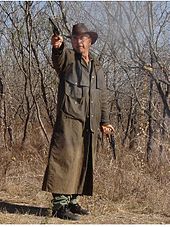
A cowboy action shooter brandishing his revolver
People relive the Wild West both historically and in popular civilisation by participating in cowboy activity shooting events,[61] where each gunslinger adopts his or her own look representing a character from Western life in the belatedly 1800s, and as part of that graphic symbol, chooses an alias to become by. The sport originated in Southern California, USA, in the early on 1980s but is now skilful in many places with several sanctioning organizations including the Single Action Shooting Gild (SASS), Western Action Shootists Association (WASA), and National Congress of Old West Shooters (NCOWS), also as others in the U.s. and in other countries. There are dissimilar categories shooters can compete in. There'south the gunfighter, frontiersman, classic cowboy and duelist – each with its own specifications.[62]
Aslope the iconic cowboy, gunfighters take become a cultural image of the American people away, and also every bit an arcadian image of violence, frontier justice, and chance.[63] [64] Even outside of the Western genre, the term 'gunslinger' has been used in modern times to describe someone who is fast and authentic with pistols, either in real life or in other fictional activity genres.[65] [66] [67]
The quick draw which gunfighters help popularize, is still an important skill in the American military and law enforcement communities.[67] [68]
In popular culture [edit]
Gunfighters have been featured in media even outside the Western genre, often combined with other elements and genres, mainly scientific discipline-fiction space Westerns, steampunk, and the contemporary setting.[vii] Abilities, clothing and attitude associated with gunfighters are seen in many other genres. An example of these is Han shot outset, in which Han Solo, a gunfighter-like protagonist in Star Wars, kills his opponent with a subtle, nether-the-table draw.[69] He besides wore his holster depression on, and tied to, the thigh with a cutaway for the trigger. Roland Deschain from the fantasy serial The Dark Belfry is a gunfighter pitted confronting fantasy-themed monsters and enemies. Inspired by the "Human with No Name" and other spaghetti-western characters, he himself is detached or unsympathetic, often reacting as uncaring or angry at signs of cowardice or self-pity, even so he possesses a strong sense of heroism, ofttimes attempting to assist those in demand, a morality much seen in Westerns.[70]
Jonah Hex, from DC Comics, is a ruthless bounty hunter jump past a personal lawmaking of accolade to protect and avenge the innocent. IGN ranked Jonah Hex the 73rd greatest comic book hero of all time.[71] Throughout the DC Universe, Hex has been, on many occasions, transported from the Sometime West to the contemporary setting and beyond. Even in an unfamiliar territory and fourth dimension menstruum, Hex managed to outgun his enemies with more than advanced weaponry. Two-Gun Child is another comic volume gunfighter from Marvel Comics. Skilled with revolvers, he has aided many super-heroes in time to come timelines, near notably She-Hulk.[72]
Many Japanese manga and anime have likewise adopted the western genre. Yasuhiro Nightow is known for creating the infinite Western Trigun.[73] The story'southward protagonist, Vash the Stampede, is a wandering gunslinger with a nighttime past. Unlike other violence-themed gunslingers, Vash carries a Shane-similar pacifist attitude, and avoids killing men, fifty-fifty unsafe enemies. Backside him is the gun-toting priest named Nicholas D. Wolfwood, who carries with him a heavy motorcar gun and rocket launcher shaped like a cross. Nicholas is more than fierce than Vash, and the two would often argue about killing opponents. Other western genre themed manga and anime include Cowboy Bebop and Kino's Journey, who both incorporate knight-errant gunslinger themes.[74] [75]
Modern-24-hour interval western gunslingers have also appeared in recent Neo-Westerns.[76] Raylan Givens from the television series Justified shares the same ambiguous moral lawmaking of an Old W sheriff, fifty-fifty using a fast describe to dispatch his enemies. The hitman Anton Chigurh from No Country for Sometime Men shares many elements of a hunted outlaw.[77] Additionally, the comic book grapheme Vigilante is a self-proclaimed gunfighter born in the 1940s.[78]
Gunfighters accept also been featured in many video games, both in traditional Former Westward, and in contemporary and hereafter settings. Colton White was the protagonist of 2005'due south acknowledged western video game Gun.[79] Another well-known video game Western protagonist is John Marston from Reddish Dead Redemption, who was nominated for 2010 Spike's Video Game Awards, also as his friend Arthur Morgan in Scarlet Dead Redemption two.[fourscore] The New York Times stated: "he and his creators conjure such a convincing, cohesive and enthralling re-imagination of the real world that it sets a new standard for sophistication and appetite in electronic gaming."[81] The chief character Caleb in the video games Blood and Blood II: The Chosen is also a onetime Old Due west gunfighter.[82] Gunfighter is besides a callsign for a grouping of ii Apache Helicopters in the video game Medal of Honor. They appear on mission named "Gunfighters", and the thespian will act as Captain Brad "Hawk" Hawkins from 1st Aviation Regiment.[83]
Former professional American football quarterback Brett Favre was nicknamed "The Gunslinger" due to his rural, Southern upbringing and his wild, risky, quick-throwing play-manner that led him to great success in the National Football game League.[84] [85]
Come across besides [edit]
- Gun fu
References [edit]
- ^ a b c d e f chiliad h Henry Gaudet. "What Is a Gunslinger?". Wisegeek. September 22, 2014
- ^ The terms "gunslinger" and "showdown" were unknown in the Wild West. Gunslinger (or Gun Slinger)
- ^ a b Rosa (1969) vi.
- ^ Rosa (1969) vii.
- ^ Chuck Parsons, Clay Allison: Portrait of a Shootist (Seagraves, Texas: Pioneer, 1983)
- ^ Bishop, William Henry (1888). Old Mexico and her Lost Provinces: a Journey in Mexico, Southern California. Harper and Brothers. p. 490. Retrieved May 3, 2011.
- ^ a b c Tim Dirks. "Western Films Part 1". Filmsite.org.
- ^ H. Lo. "What Are the Characteristics of the Western Genre?". Wisegeek. September eleven, 2014
- ^ a b c d e Miss Cellania. "The Truth About Gunfights in the One-time West". Neutorama. June 7, 2012
- ^ a b c d e f "One-time West Legends". Legends of America.
- ^ O'Neal (1979) p. three
- ^ a b Adams, Cecil (2004-06-25). "Did Western gunfighters really face off one-on-one?". Straight Dope . Retrieved Oct 4, 2014. June 25, 2004
- ^ "MythBusters: Hollywood Gunslingers". Discovery Channel. Retrieved February 2, 2014.
- ^ Ed McGivern'due south Book of Fast and Fancy Revolver Shooting. Skyhorse Publishing Inc. ISBN 978-1-60239-086-7.(2007) pp. 101–103
- ^ a b c d "One-time West Myths ... And Things Picayune Known". Shotdoc.com. Retrieved Feb ii, 2014.
- ^ McLachlan, Sean (2013). Tombstone – Wyatt Earp, the O.K. Corral, and the Vendetta Ride 1881–82. Osprey Publishing. p. 50. ISBN978-1-78096-194-i . Retrieved 2 August 2013.
- ^ "Top Shot (flavour iii): Episode 7 ("Tricked Out")". TV Guide. September 20, 2011
- ^ Ayoob, Massad (September–October 2006). "Borderland Manner Handguns For The Modern Backwoods Home". Weald Home Magazine. Retrieved September 27, 2014.
- ^ a b Fournier, Richard. "Mexican State of war Vet Wages Deadliest Gunfight in American History", VFW Magazine (January 2012), p. xxx.
- ^ "An Outlaw's Armory". American Experience.
- ^ a b c "Wild bill vs Tutt duel". Spartacus Educational. Archived from the original on July 19, 2013. Retrieved February 2, 2014.
- ^ "The Indian Wars". Boundless. Archived from the original on November 25, 2015. Retrieved Oct 5, 2014.
- ^ Cellania, Miss. "The Meanest Towns in the West". Neotorama. November 21, 2011
- ^ "The Law in Tombstone". Archived from the original on 13 December 2013. Retrieved 8 March 2014.
- ^ a b c d Petzal, David. "Five Greatest Gunfights of the Onetime West". Field and Stream . Retrieved April xiv, 2014.
- ^ Tombstone Nugget; October 27, 1881 article
- ^ El Paso Times commodity documenting the event
- ^ Bureau of the Census (1894). Study on Indians taxed and Indians not taxed in the United States (except Alaska). p. 637. ISBN9780883544624.
- ^ Raynor, Jessica. "Baton Dixon". Amarillo.com. Retrieved April 19, 2014.
- ^ Clayburn, Glenn (September 12, 2013). "6 Real-Life Gunslingers Who Put Baton the Kid to Shame". Croaky. Retrieved Apr fourteen, 2014.
- ^ a b "Wild Bill Hickok fights first western showdown". History.com. Archived from the original on Oct 6, 2014. Retrieved October four, 2014.
- ^ "Politics And Pistols: Dueling In America". History Detectives. PBS. Retrieved 2012-07-22 .
- ^ Wyatt-Brown, Bertram. 1982. Southern Accolade: Ethics and Behavior in the Former South. New York: Oxford University Printing. Pages 167 and 350–351. ISBN 0195325176
- ^ Bong, Bob Boze (May 2010). "Wyatt Goes Rogue". True West Magazine. Archived from the original on December 22, 2014. Retrieved October 24, 2014.
- ^ Isenberg, Andrew C. (2013). Wyatt Earp: A Vigilante Life. Loma and Wang; Get-go Edition. p. Affiliate 4: Jerk Your. ISBN978-0809095001.
- ^ DeArment, Robert One thousand. Deadly Dozen: Forgotten Gunfighters of the Old Due west, Volume 3. Academy of Oklahoma Press; Get-go edition (March 15, 2010). p. 23-24. ISBN 978-0806140766
- ^ "This Twenty-four hours in History: Doctor Holliday". History.com.
- ^ "Gunfighters Part 4". Legends of America.
- ^ "Gunfights: Long Co-operative Saloon Shootout". Legends of America. Archived from the original on 2008-03-21.
- ^ "Jim Levy - The Jewish Gunfighter". Legends of America.
- ^ Shoot-out (1877) Sometime West Gunfights - Page 2 Archived 2012-07-19 at the Wayback Machine Legends of America
- ^ Grady, David P. (July–August 1996). "American Cowboy". American Cowboy: 64.
- ^ Desert Evening News November 20, 1903
- ^ Jim Levy - The Jewish Gunfighter
- ^ McGrath, Roger D. Gunfighters, Highwaymen & Vigilantes: Violence on the Frontier. Academy of California Press (March 23, 1987). pp. 99- 100. ISBN 978-0520060265.
- ^ "Masterson Laments Loss of Pistol. Was Confiscated, but He Hopes to Get Information technology Back at Auction Sale". New York Times. June 8, 1902.
"Bat" William B. Masterson, in his ain parlance, is "sore." His forty-five caliber pistol which he has carried since the strenuous days of his young manhood has been confiscated.
- ^ Dworkin, Marker. "Charlie Siringo, Letter Writer". Western Outlaw Lawman Association Journal. Winter 2003, Vol. 11 (4): sixteen–18. Archived from the original on 2011-06-04. Retrieved 2011-04-25 .
- ^ Gatto, Steve. "Wyatt Earp History Folio". WyattEarp.Net. Retrieved February 25, 2011.
- ^ Ashford, David (September 3, 1994). "First action hero: Wyatt Earp was an elderly movie groupie who failed to make it every bit an extra ..." The Contained. London. Retrieved January ten, 2011. [ dead link ]
- ^ Douglas Linder (2005). "Testimony of Virgil Earp in the Preliminary Hearing in the Earp Case". Famous Trials: The O. M. Corral Trial. Archived from the original on 2011-02-03. Retrieved 2011-02-06 .
- ^ Wilkinson, Darryl (1992-07-22). "Johnny Ringo Called Gallatin Dwelling house as a Boy". Gallatin North Missourian. Archived from the original on 2007-09-29. Retrieved fifteen February 2013.
- ^ Metz, Leon Claire. 1979. Dallas Stoudenmire: El Paso Marshal. Norman, University of Oklahoma Press. 162 p.
- ^ Cunningham, Sharon. – "The Allison Association – A Visit"' Archived 2007-09-27 at the Wayback Machine. – Western Outlaw. – (Adobe Acrobat *.PDF certificate).
- ^ "The Story of the "King of the Cowboys"". Johnnyringo.com. Retrieved October 4, 2014.
- ^ "Butch Cassidy and Sundance Kid". Wyoming Tales and Trails. Archived from the original on Oct one, 2011. Retrieved August 25, 2011.
- ^ Barra, Allen (2008). Inventing Wyatt Earp: His Life and Many Legends. Lincoln, Nebraska: University of Nebraska Printing. p. 440. ISBN978-0-8032-2058-4. p.117
- ^ Carlson, Chip (2001). Tom Horn: Blood on the Moon: Nighttime History of the Murderous Cattle Detective. High Plains Press. pp. 22–28. ISBN978-0-931271-58-8.
- ^ Woog, Adam (February 28, 2010). Wyatt Earp. Chelsea Business firm Publications. ISBN978-ane-60413-597-8. p.31
- ^ a b c Rosa (1969) p.7-8
- ^ Nolan, Frederick (2009) [March 1992]. The Lincoln County War: A Documentary History (Revised ed.). Santa Atomic number 26, NM: Sunstone Presse. pp. 510, 219. ISBN978-0-86534-721-2.
- ^ Taffin, John (2005). The Gun Digest Book of Cowboy Action Shooting: Guns · Gear · Tactics. Gun Digest Books. p. 256. ISBN978-0-89689-140-1.
- ^ Henri Brickey. "Modern-24-hour interval gunslingers relish competition and camaraderie". Lubbockonlinecom. July 03, 2008
- ^ Leon Claire Metz (2003). Encyclopedia of Lawmen, Outlaws, and Gunfighters . Facts on File. ISBN978-0816045433. Introduction and p. 63
- ^ Microsoft Encarta 2007 edition: Cowboy
- ^ "Oxford definition: Gunslinger". Oxford Lexicon. Retrieved April 12, 2014.
- ^ "'Gunslinger' definition". Merriam-Webster Lexicon Online. Retrieved Oct 6, 2014.
- ^ a b Don Mann (August 2010). The Mod Day Gunslinger: The Ultimate Handgun Grooming Manual . Skyhorse Publishing. ISBN978-1602399860. Affiliate ane
- ^ "Point shooting" (PDF). Archived from the original (PDF) on May 21, 2012. Retrieved February 2, 2014.
- ^ Howell, Peter, "At last, Han shot first" Archived 2012-11-03 at the Wayback Machine, Toronto Star, May 12, 2006
- ^ King, Stephen; Robin Furth (December five, 2006). Stephen King's The Nighttime Tower: The Consummate Concordance. Scribner. ISBN978-0-7432-9734-9.
- ^ "Jonah Hex is number 73". IGN . Retrieved May 11, 2011.
- ^ She-Hulk vol. 2, #three (February. 2006).
- ^ "Trigun: Multiple Bullets TPB" (in Japanese). Shonen Gahosha. Retrieved 2014-02-03 .
- ^ Mary. "STAFF PICKS: OLD SCHOOL CARTOONS". The Vault Magazine. Archived from the original on May 23, 2013. Retrieved May 12, 2012.
- ^ "キノの旅XVII" [Kino's Journey XVII] (in Japanese). ASCII Media Works. Retrieved October 17, 2013.
- ^ "Genre: Western". The Script Lab. 2011-03-26.
- ^ "Empire 100 Greatest Movie Characters". Empire.com. 2012-03-24. Retrieved 2012-03-24 .
- ^ Activeness Comics #42 (November 1941) Mort Weisinger
- ^ "Activity Game of the Year". GameSpy. Archived from the original on 2009-04-30.
- ^ "Nominees for Spike Video Game Awards 2010 revealed". Destructoid. Nov 17, 2010. Retrieved April nine, 2013.
- ^ Schiesel, Seth (May 17, 2010). "Style Down Deep in the Wild, Wild West". The New York Times.
- ^ Monolith Productions. Blood (PC). GT Interactive.
In an age and a region renowned for cruelty and violence, Caleb was legendary. Built-in in western Texas in 1847, he had sealed a reputation every bit a merciless gunfighter past the age of 17.
- ^ "Gunfighters Walkthrough - Medal of Honor Game Guide". Game Pressure.
- ^ "The Gunslinger – Brett Favre". Staugnews.com. Archived from the original on 2012-09-21. Retrieved 2012-08-19 .
- ^ Mike Sando (4 March 2008). "Gunslinger mentality defined Favre". ESPN.
Sources [edit]
- O'Neal, Bill (1979). Encyclopedia of Western Gunfighters. University of Oklahoma Press.
- Rosa, Joseph G. (1969). The Gunfighter: Man or Myth? . University of Oklahoma Press.
Farther reading [edit]
- Cunningham, Eugene (1934). Triggernometry: A Gallery of Gunfighters (1996 ed.). University of Oklahoma Printing.
- "Slap Leather, Gunfighter Myth". utexas.edu. Archived from the original on 2007-02-13.
Source: https://en.wikipedia.org/wiki/Gunfighter
0 Response to "Air Combat Gunfighters Are Obsolete Again"
Enviar um comentário