Tears for Fearseverybody Wants to Rule the World Album Art
As a general rule, nostalgia in art is bad. It's a gimmick that makes people like your art more than than they should, because it's familiar, and it is never seriously critical. Nostalgia is an intellectual and artful crutch that prevents cultural artifacts from reflecting their own epochs.
But there'southward a recent trend being made and shown that I support, and it'due south not simply considering of my weakness for Seinfeld and Vaporwave music. It's a whole host of new art that uses the aesthetics of '90s graphic pattern to become beautiful and new.
You know what I mean considering you've noticed this yourself: It'south in the denim of Korakrit Arunanondchai'south piece of work, for instance, and in the Lisa Frank-esque neons of Alex Da Corte and the later piece of work of Peter Saul. It's also in Sam McKinniss'southward portraits of Prince and Michelle Pfeiffer's Catwoman, and in Kerstin Brätsch's gradient-heavy loops, reminiscent of a broken Magic Eye repeating itself in the incorrect way. All of it is wholly deep-fried in that decade.

Take Laura Owens'due south untitled tiptop-floor installation at the Whitney Museum of American Art in New York, which closed in Feb. Those giant notebook pages embossed with graphics and scented markers build to a apprehensive, Expressionist still life in the corner, retaining the garish Zack Morris palette. That slice happened to exist a recreation of her immature son's notebook, only at that place'due south a childlike quality to all such art.
Ruth Root makes her own spandex with children'south pajama-similar designs and wraps information technology around sheet, and Christina Quarles sneaks such colors and graphic-pattern elements into her otherwise dark scenes of body dysmorphia. Quarles is young, and most of the people creating this kind of fine art today were children in the '90s, which helps inspire the feeling of play.

And then is it nostalgia? This new wave feels different than the usual civilisation mining that goes on 20 to xxx years after a decade has ended, the mode the cool people of the 2040s will probably endeavour to mimic our tragic current era. For one thing, it's so widespread. For another, the 1990s didn't have as cohesive a look as the '70s and '80s did. Instead of Halston bias cuts and bong-bottoms, the outfits ranged from grunge to Hackers to dorky dad. And, like the Rachel haircut, all of it has aged terribly. (Nineties-inspired looks accept been appearing on the runways for some time now.)
"Since the outset of her career in the mid-'90s, Laura Owens has been actively challenging our assumptions about what counts as beautiful or ugly in art—and beyond," says Scott Rothkopf, who curated Owens's show at the Whitney. "Her assault on the conventions of good gustation is why many of her paintings don't settle into chic interior decor. Just for me, this is office of their strange and lasting ability."
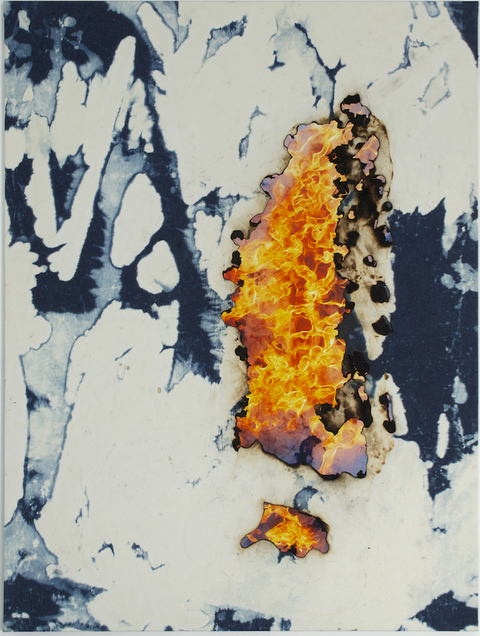
The ugliness adds something here, a certain liberation. Perhaps that'south 1 of the reasons the raver colors of the era have been associated with the new psychedelia: It's transgressive to borrow aesthetic elements of our recent by that many would rather forget. Some people I overheard at the Whitney sounded like they thought the goal of the museum, in hosting the Owens survey, was the same as the Nazis' in the Degenerate Art Exhibition of 1937. I'chiliad not sure that tracks.
What does it all mean? This is good fine art, then yous tin't actually generalize about it. It all says something unique about itself, about the looks it's borrowing, and about our electric current era. But for the portion of it that's been fabricated in the by couple of years, I practise have a question: Might this trend take something to do with the fact that we've had to stare at two '90s characters, Hillary Clinton and Donald Trump, for the last 3 years?

The '90s, after all, were the last time we thought of lodge as something that would go along getting improve and amend. The stop of the decade was most the end of optimism itself, because after that came 9/eleven, and we're all the same living out the reality that followed.
If artists are returning to the '90s, it may be that they suspect, similar the balance of us, that things have gone downhill culturally e'er since. At that place's clearly some promise hither. Information technology's thin, and information technology's fragile. And for some, information technology'southward Day-Glo—only information technology works.
This content is created and maintained by a 3rd party, and imported onto this page to help users provide their email addresses. You may exist able to find more information about this and similar content at piano.io
Source: https://www.elledecor.com/life-culture/a22854694/nostalgia-in-art-world/
0 Response to "Tears for Fearseverybody Wants to Rule the World Album Art"
Enviar um comentário