Review for Chapter 2 Algebra 2 Big Ideas
If you stuck at solving complex problems on Quadratic Functions and then terminate computing the trouble and offset practicing the concepts of Chapter 2 from Large Ideas Math Algebra 2 Answers. Information technology holds all affiliate'southward answer keys in pdf format. Hither, in this commodity, you will collect the details about Big Ideas Math Algebra ii Answers Chapter ii Quadratic Functions. This cloth is the complete guide for high schoolhouse students to acquire the concepts of the Quadratic functions. Hence, download the topic-wise BIM Algebra 2 Ch ane Textbook Solutions from the below available links and get-go your practise sessions before any examination.
Big Ideas Math Book Algebra 2 Answer Central Chapter 2 Quadratic Functions
Students tin can access these Topicwise Big Ideas Math Algebra ii Ch i Answers online or offline whenever required and kickstart their preparation. Y'all tin hands clear all your bailiwick-related queries using the BIM Algebra 2 Ch 1 Answer cardinal. This BIM Textbook Algebra two Chapter 1 Solution Key includes various easy & complex questions belonging to Lessons 2.1 to 2.4, Assessment Tests, Affiliate Tests, Cumulative Assessments, etc. Apart from the Quadratic functions exercises, you tin also detect the exercise on the Lesson Focus of a Parabola. Excel in mathematics examinations by practicing more and more using the BigIdeas Math Algebra 2 Ch two Reply fundamental.
- Quadratic Functions Maintaining Mathematical Proficiency – Page 45
- Quadratic Functions Mathematical Practices – Page 46
- Lesson 2.1 Transformations of Quadratic Functions – Folio (48-54)
- Transformations of Quadratic Functions 2.i Exercises – Page (52-54)
- Lesson 2.2 Characteristics of Quadratic Functions – Page (56-64)
- Characteristics of Quadratic Functions two.2 Exercises – Page (61-64)
- Quadratic Functions Study Skills Using the Features of Your Textbook to Ready for Quizzes and Tests – Page 65
- Quadratic Functions 2.1 – 2.2 Quiz – Page 66
- Lesson two.3 Focus of a Parabola – Page (68-74)
- Focus of a Parabola 2.3 Exercises – Page (72-74)
- Lesson two.4 Modeling with Quadratic Functions – Page (76-82)
- Modeling with Quadratic Functions 2.four Exercises – Page (80-82)
- Quadratic Functions Performance Task: Accident Reconstruction – Page 83
- Quadratic Functions Affiliate Review – Folio (84-86)
- Quadratic Functions Chapter Test – Page 87
- Quadratic Functions Cumulative Assessment – Folio (88-89)
Quadratic Functions Maintaining Mathematical Proficiency
Observe the x-intercept of the graph of the linear equation.
Question 1.
y = 2x + vii
Question 2.
y = -6x + 8
Question 3.
y = -10x – 36
Question four.
y = 3(x – 5)
Question v.
y = -4(x + 10)
Question half-dozen.
3x + 6y = 24
Find the distance between the two points.
Question seven.
(2, 5), (-4, 7)
Question 8.
(-one, 0), (-8, four)
Question nine.
(3, ten), (5, 9)
Question 10.
(7, -4), (-five, 0)
Question 11.
(4, -eight), (iv, 2)
Question 12.
(0, 9), (-3, -6)
Question xiii.
ABSTRACT REASONING Employ the Distance Formula to write an expression for the distance between the two points (a, c) and (b, c). Is there an easier mode to find the distance when the x-coordinates are equal? Explain your reasoning
Quadratic Functions Mathematical Practices
Monitoring Progress
Determine whether the syllogism represents right or flawed reasoning. If flawed, explain why the conclusion is non valid.
Question 1.
All mammals are warm-blooded.
All dogs are mammals.
Therefore, all dogs are warm-blooded.
Question 2.
All mammals are warm-blooded.
My pet is warm-blooded.
Therefore, my pet is a mammal.
Question 3.
If I am sick, then I volition miss schoolhouse.
I missed school.
Therefore, I am sick.
Question 4.
If I am sick, then I volition miss school.
I did not miss school.
Therefore, I am not sick.
Lesson 2.1 Transformations of Quadratic Functions
Essential Question
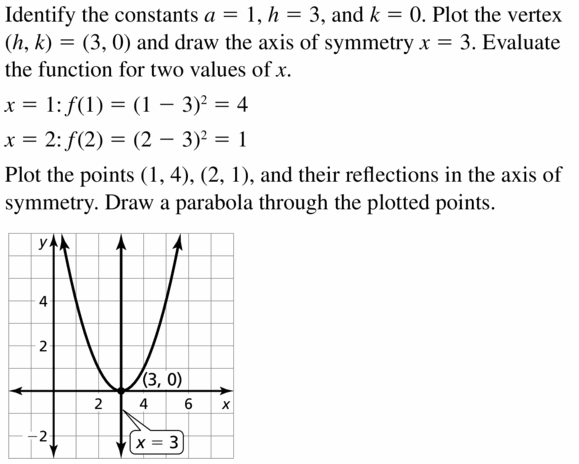
How do the constants a, h, and k bear upon the graph of the quadratic function 1000(x) = a(ten – h)2 + k?
The parent role of the quadratic family unit is f(x) = x2. A transformation of the graph of the parent part is represented by the function thou(x) = a(x – h)2 + k, where a ≠ 0.
EXPLORATION 1
Identifying Graphs of Quadratic Functions
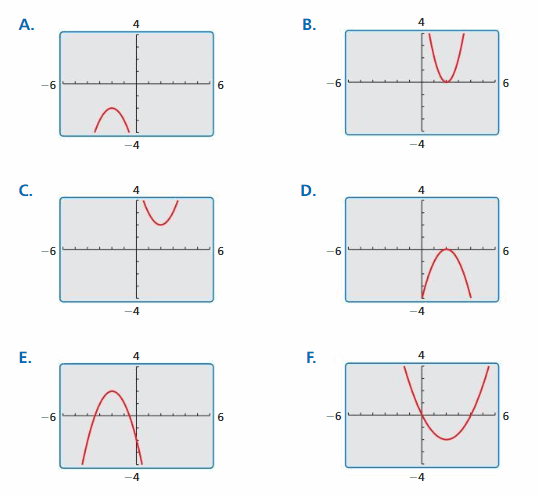
Work with a partner. Match each quadratic function with its graph. Explain your reasoning. And then use a graphing calculator to verify that your answer is right.
a. yard(x) = -(ten – 2)ii
b. chiliad(x) = (10 – 2)ii + 2
c. m(x) = -(x + 2)2 – ii
d. one thousand(x) = 0.5(ten – 2)2 + 2
east. thousand(ten) = 2(ten – ii)2
f. g(ten) = -(x + ii)2 + ii
Communicate Your Respond
Question 2.
How practice the constants a, h, and yard affect the graph of the quadratic function k(x) =a(x – h)2 + k?
Question 3.
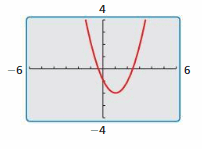
Write the equation of the quadratic function whose graph is shown at the right. Explicate your reasoning. So use a graphing computer to verify that your equation is right.
2.1 Lesson
Monitoring Progress
Describe the transformation of f(x) = xtwo represented by m. And then graph each part.
Question one.
g(x) = (ten – 3)2
Question 2.
g(ten) = (ten + 2)ii – 2
Question 3.
grand(x) = (x + 5)2 + 1
Draw the transformation of f(x) = 102 represented by yard. Then graph each part.
Question 4.
g(x) = (\(\frac{1}{3} x\))two
Question 5.
g(x) = 3(x – i)two
Question 6.
g(10) = -(x + 3)2 + two
Question seven.
Permit the graph of yard exist a vertical shrink by a factor of \(\frac{i}{2}\) followed by a translation ii units upwards of the graph of f(ten) = x2. Write a rule for grand and identify the vertex.
Question viii.
Let the graph of g be a translation 4 units left followed by a horizontal shrink past a factor of \(\frac{i}{3}\) of the graph of f(ten) = x2 + ten. Write a dominion for g.
Question 9.
WHAT IF? In Instance 5, the water hits the ground 10 feet closer to the burn down truck afterward lowering the ladder. Write a part that models the new path of the water.
Transformations of Quadratic Functions 2.1 Exercises
Vocabulary and Cadre Concept Cheque
Question 1.
Complete THE SENTENCE The graph of a quadratic function is called a(northward) ________.
Answer:

Question 2.
VOCABULARY Identify the vertex of the parabola given by f(x) = (ten + 2)two – 4.
Respond:
Monitoring Progress and Modeling with Mathematics
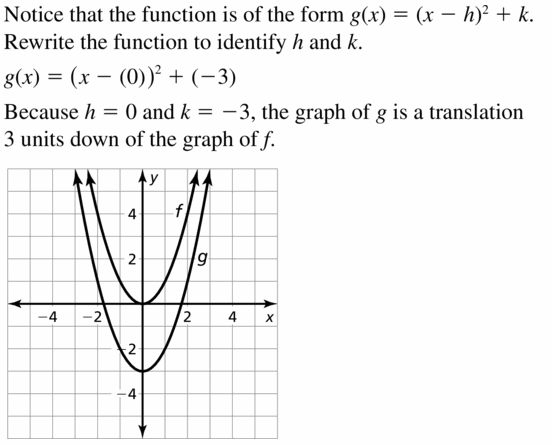
In Exercises 3–12, describe the transformation of f(ten) = x2 represented by g. And so graph each part.
Question 3.
g(x) = 102 – three
Answer:
Question 4.
chiliad(ten) = x2 + 1
Answer:
Question 5.
g(ten) = (x + 2)ii
Reply:
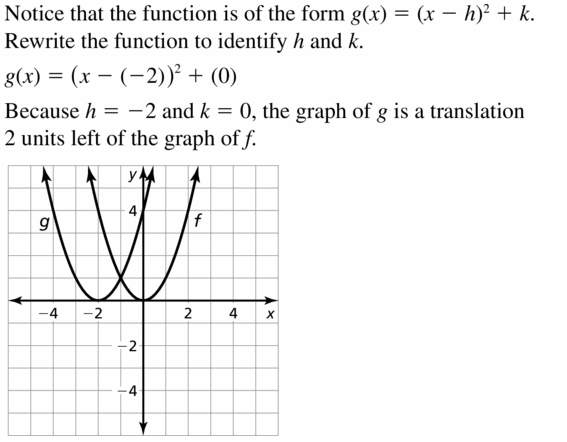
Question 6.
g(x) = (x – four)ii
Reply:
Question 7.
g(x) = (x – i)two
Answer:
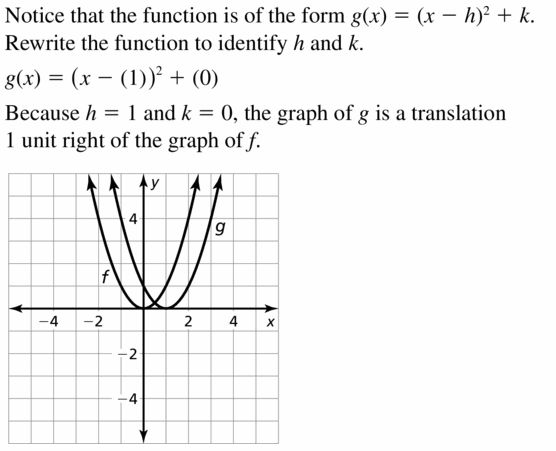
Question 8.
g(10) = (x + iii)2
Answer:
Question nine.
g(x) = (x + 6)2 – 2
Answer:
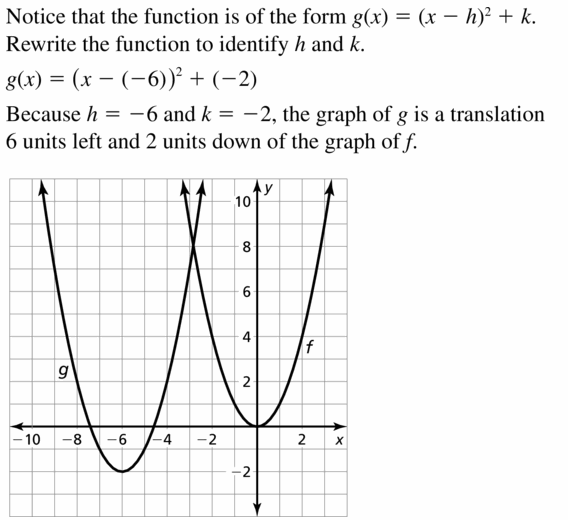
Question ten.
g(x) = (x – ix)2 + 5
Answer:
Question xi.
thou(x) = (x – seven)2 + 1
Respond:
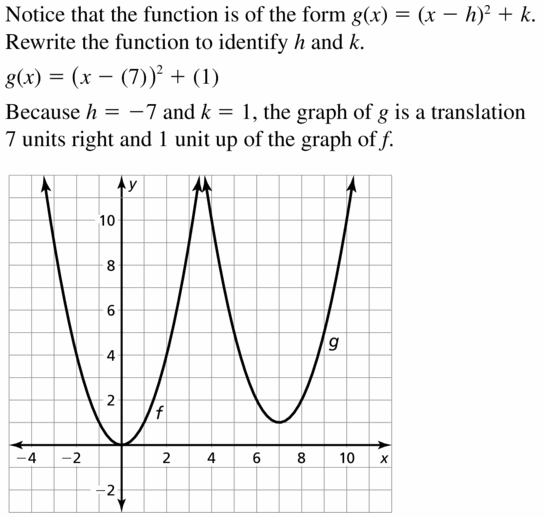
Question 12.
chiliad(x) = (x + 10)2 – 3
Answer:
ANALYZING RELATIONSHIPS In Exercises thirteen–sixteen, match the office with the correct transformation of the graph of f. Explain your reasoning.
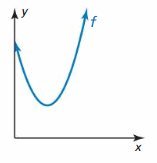
Question 13.
y = f(x – 1)
Answer:

Question fourteen.
y = f(x) + i
Answer:
Question 15.
y = f(x – 1) + i
Reply:

Question 16.
y = f(ten + ane)
Answer:
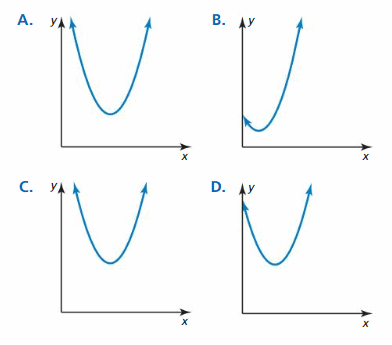
In Exercises 17–24, draw the transformation of f(x) = xtwo represented by thousand. Then graph each role.
Question 17.
g(x) = -x2
Answer:
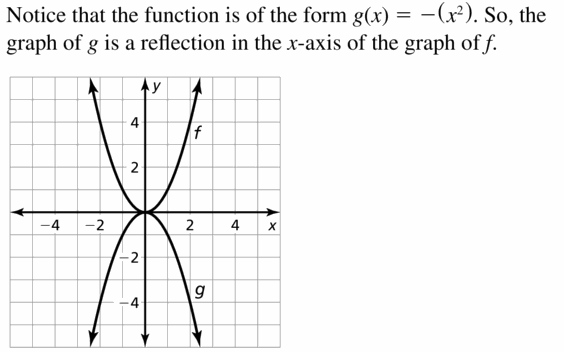
Question 18.
g(x) = (-ten)2
Answer:
Question 19.
yard(x) = 3x2
Answer:
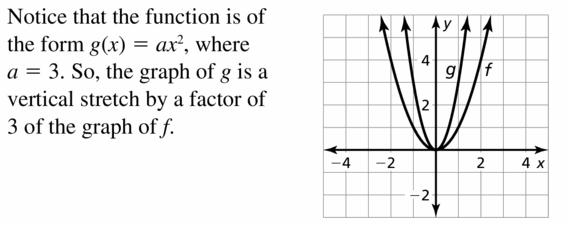
Question twenty.
chiliad(x) = \(\frac{i}{iii}\)10two
Answer:
Question 21.
g(ten) = (2x)two
Answer:
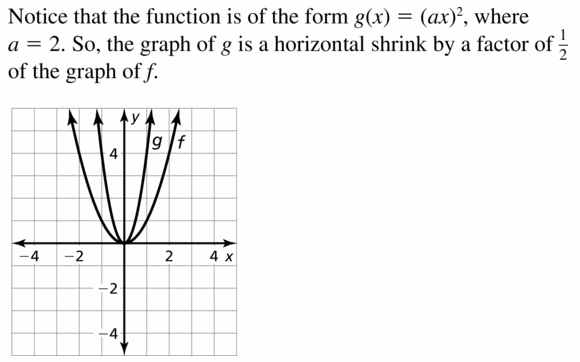
Question 22.
g(ten) = -(2x)2
Answer:
Question 23.
g(x) = \(\frac{1}{v}\)x2 – four
Respond:
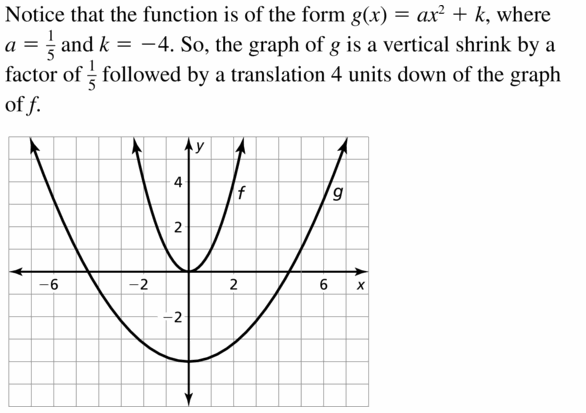
Question 24.
g(x) = \(\frac{i}{2}\)(ten – ane)two
Answer:
Mistake Assay In Exercises 25 and 26, depict and correct the error in analyzing the graph of f(10) = −6x2 + iv.
Question 25.
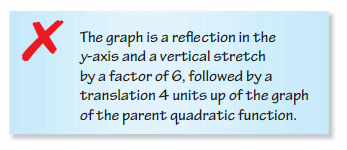
Answer:

Question 26.
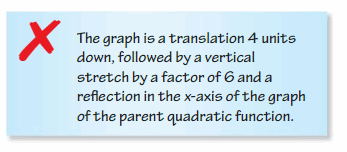
Answer:
USING STRUCTURE In Exercises 27–30, draw the transformation of the graph of the parent quadratic part. Then identify the vertex.
Question 27.
f(x) = 3(ten + 2)ii + 1
Answer:

Question 28.
f(ten) = -iv(x + 1)2 – five
Answer:
Question 29.
f(x) = -2xtwo + 5
Reply:

Question xxx.
f(x) = \(\frac{1}{two}\)(ten – one)2
Answer:
In Exercises 31–34, write a rule for g described by the transformations of the graph of f. And so place the vertex.
Question 31.
f(10) = 102 vertical stretch by a gene of 4 and a reflection in the x-axis, followed by a translation 2 units upward
Answer:
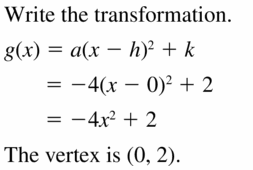
Question 32.
f(x) = x2; vertical shrink past a cistron of \(\frac{1}{three}\) and a reflection in the y-axis, followed by a translation iii units right
Answer:
Question 33.
f(x) = 8xtwo – 6; horizontal stretch by a gene of 2 and a translation 2 units up, followed by a reflection in the y-centrality
Reply:
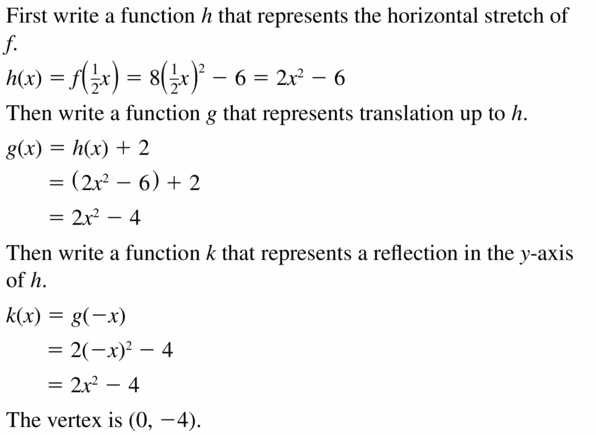
Question 34.
f(ten) = (x + 6)2 + 3; horizontal compress by a cistron of \(\frac{one}{2}\) and a translation 1 unit of measurement down, followed past a reflection in the x-centrality
Answer:
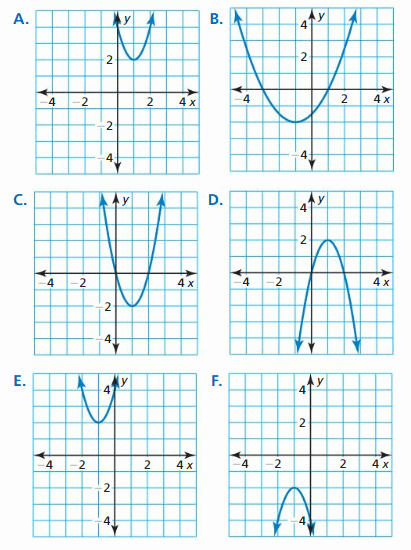
USING TOOLS In Exercises 35–40, match the office with its graph. Explicate your reasoning.
Question 35.
1000(x) = ii(x – i)2 – 2
Respond:

Question 36.
g(x) = \(\frac{1}{ii}\)(ten + 1)2 – 2
Reply:
Question 37.
g(10) = -2(x – 1)two + ii
Answer:

Question 38.
g(x) = 2(ten + 1)2 + two
Answer:
Question 39.
g(x) = -2(ten + 1)ii – ii
Respond:

Question 40.
g(10) = 2(10 – 1)2 + 2
Reply:
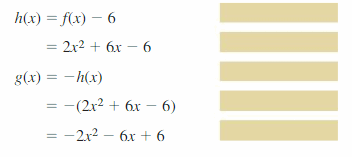
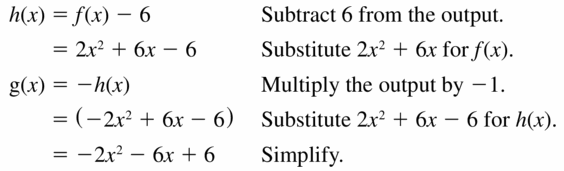
JUSTIFYING STEPS In Exercises 41 and 42, justify eachstep in writing a function g based on the transformationsof f(x) = 2x2 + 6x.
Question 41.
translation 6 units down followed by a reflection in the 10-axis
Answer:
Question 42.
reflection in the y-axis followed by a translation 4 units right
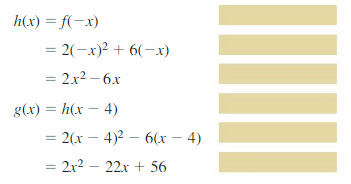
Respond:
Question 43.
MODELING WITH MATHEMATICS The function h(x) = -0.03(10 – 14)2 + 6 models the leap of a red kangaroo, where x is the horizontal distance traveled (in feet) and h(x) is the summit (in feet). When the kangaroo jumps from a higher location, it lands 5 anxiety further abroad. Write a function that models the 2nd bound.
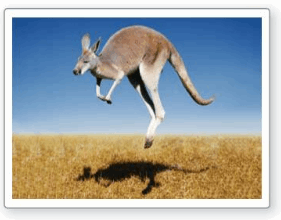
Answer:
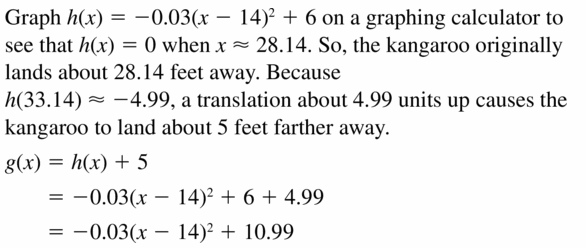
Question 44.
MODELING WITH MATHEMATICS The role f(t) = -16t2 + 10 models the elevation (in feet) of an object t seconds after it is dropped from a meridian of 10 anxiety on Earth. The same object dropped from the aforementioned height on the moon is modeled past one thousand(t) = –\(\frac{8}{3}\)t2 + 10. Describe the transformation of the graph of f to obtain thousand. From what tiptop must the object be dropped on the moon and then it hits the ground at the same time equally on Earth?
Answer:
Question 45.
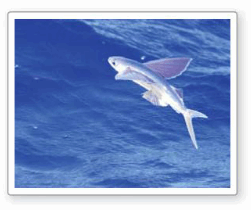
MODELING WITH MATHEMATICS Flight fish use their pectoral fins similar airplane wings to glide through the air.
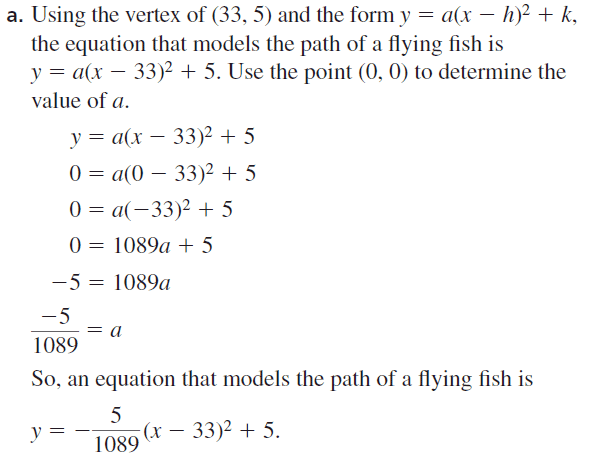
a. Write an equation of the form y = a(x – h)2 + k with vertex (33, v) that models the flight path, assuming the fish leaves the h2o at (0, 0).
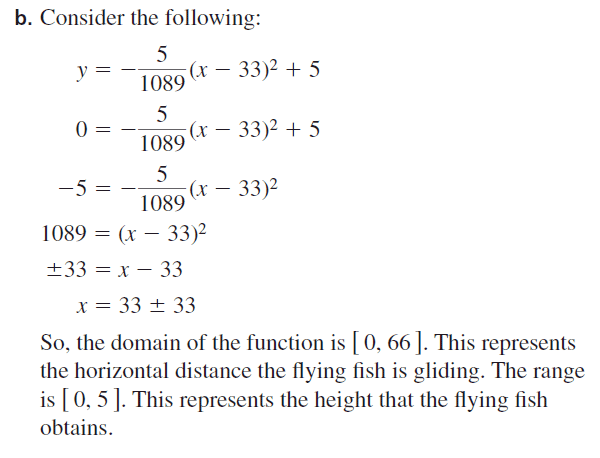
b. What are the domain and range of the function? What do they represent in this situation?
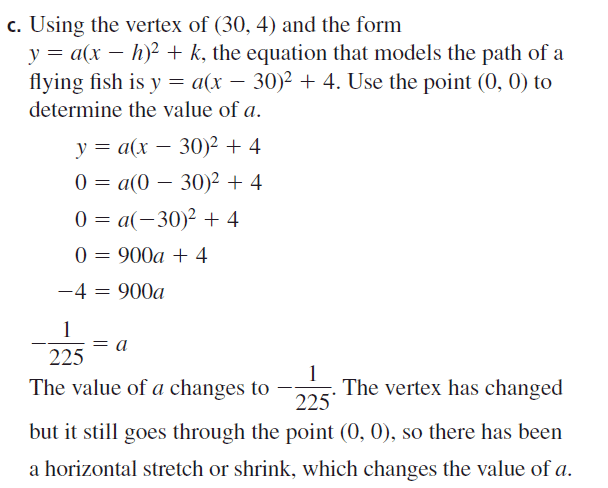
c. Does the value of a change when the flying path has vertex (xxx, 4)? Justify your answer.
Respond:
Question 46.
HOW Practise You lot SEE IT? Draw the graph of thou every bit a transformation of the graph of f(x) = x2.
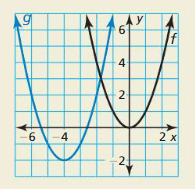
Answer:
Question 47.
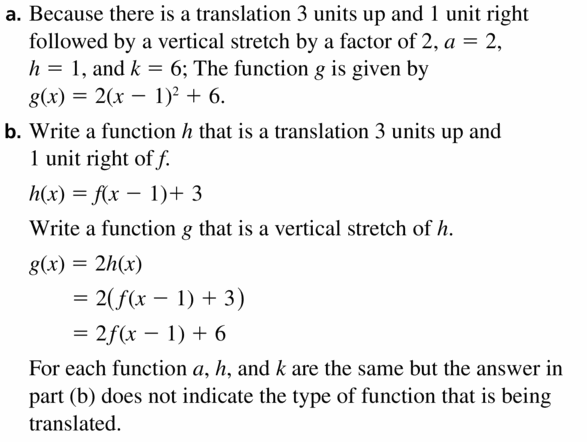
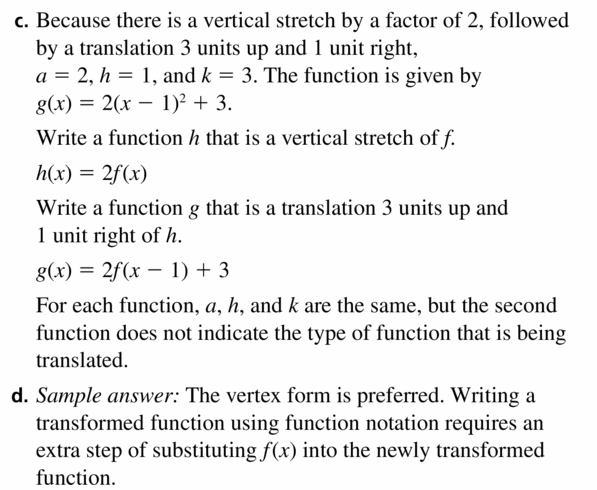
COMPARING METHODS Allow the graph of g be a translation 3 units up and ane unit right followed by a vertical stretch by a cistron of 2 of the graph of f(ten) = 10two.
a. Place the values of a, h, and k and use vertex form to write the transformed function.
b. Use function note to write the transformed function. Compare this function with your function in role (a).
c. Suppose the vertical stretch was performed first, followed by the translations. Repeat parts (a) and (b).
d. Which method practise you prefer when writing a transformed function? Explain.
Reply:
Question 48.
THOUGHT PROVOKING A jump on a pogo stick with a conventional jump can be modeled by f(ten) = -0.v(ten – 6)2 + xviii, where x is the horizontal altitude (in inches) and f(ten) is the vertical distance (in inches). Write at least one transformation of the role and provide a possible reason for your transformation.
Respond:
Question 49.
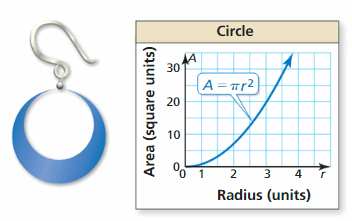
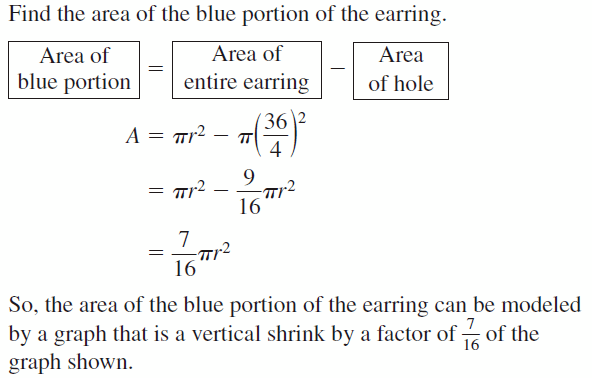
MATHEMATICAL CONNECTIONS The area of a circumvolve depends on the radius, as shown in the graph. A round earring with a radius of r millimeters has a circular hole with a radius of \(\frac{3 r}{4}\) millimeters. Describe a transformation of the graph beneath that models the area of the blue portion of the earring.
Answer:
Maintaining Mathematical Proficiency
A line of symmetry for the figure is shown in ruddy. Find the coordinates of signal A. (Skills Review Handbook)
Question 50.
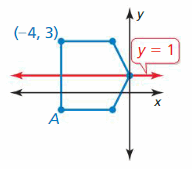
Answer:
Question 51.
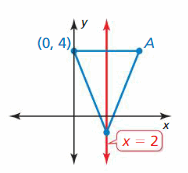
Answer:
Question 52.
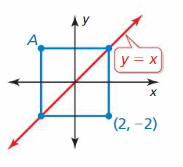
Reply:
Lesson 2.two Characteristics of Quadratic Functions
Essential Question
What blazon of symmetry does the graph of f(x) = a(x – h)two + k take and how can you describe this symmetry?
EXPLORATION ane
Parabolas and Symmetry
Work with a partner.
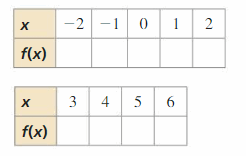
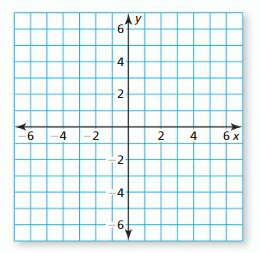
a. Consummate the table. So use the values in the table to sketch the graph of the function
f(x) = \(\frac{1}{ii}\)x2 – 2x – 2 on graph paper.
b. Use the results in function (a) to place the vertex of the parabola.
c. Detect a vertical line on your graph paper so that when you fold the paper, the left portion of the graph coincides with the right portion of the graph. What is the equation of this line? How does it relate to the vertex?
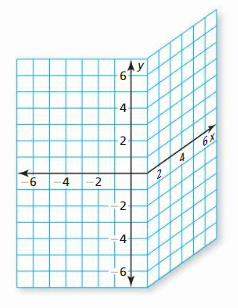
d. Bear witness that the vertex form f(10) = \(\frac{1}{2}\)(x – 2)ii – 4 is equivalent to the office given in role (a).
EXPLORATION 2
Parabolas and Symmetry
Work with a partner. Repeat Exploration 1 for the function given by f(x) = –\(\frac{1}{3}\)x2 + 2x + three = –\(\frac{1}{three}\)(10 – 3),sup>2 + 6.
Communicate Your Answer
Question iii.
What type of symmetry does the graph of f(10) = a(x – h)2 + m have and how tin y'all describe this symmetry?
Question 4.
Describe the symmetry of each graph. Then utilize a graphing reckoner to verify your answer.
a. f(x) = -(x – 1)2 + four
b. f(x) = (x + ane)2 – 2
c. f(x) = 2(x – 3)ii + 1
d. f(ten) = \(\frac{ane}{2}\)(x + 2)two
eastward. f(x) = -2x2 + iii
f. f(x) = 3(x – 5)ii + 2
2.two Lesson
Monitoring Progress
Graph the function. Label the vertex and axis of symmetry.
Question 1.
f(10) = -iii(x + i)ii
Question two.
grand(x) = two(10 – ii)2 + 5
Question 3.
h(x) = x2 + 2x – ane
Question four.
p(x) = -2x2 – 8x + 1
Question 5.
Find the minimum value or maximum value of
(a) f(x) = 4x2 + 16x – 3 and
(b) h(x) = -x2 + 5x + 9. Describe the domain and range of each function, and where each function is increasing and decreasing.
Graph the function. Label the x-intercepts, vertex, and axis of symmetry.
Question half-dozen.
f(ten) = -(x + 1)(10 + five)
Question seven.
one thousand(ten) = \(\frac{1}{4}\)(x – six)(x – 2)
Question 8.
WHAT IF? The graph of your 3rd shot is a parabola through the origin that reaches a maximum height of 28 yards when ten = 45. Compare the distance it travels before it hits the ground with the distances of the first two shots.
Characteristics of Quadratic Functions two.2 Exercises
Vocabulary and Core Concept and Check
Question 1.
WRITING Explain how to determine whether a quadratic role will take a minimum value or a maximum value.
Answer:

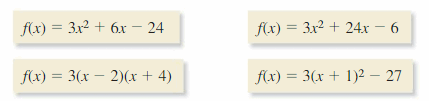
Question ii.
WHICH ONE DOESN'T Vest? The graph of which function does non belong with the other 3? Explain.
Reply:
Question iii.
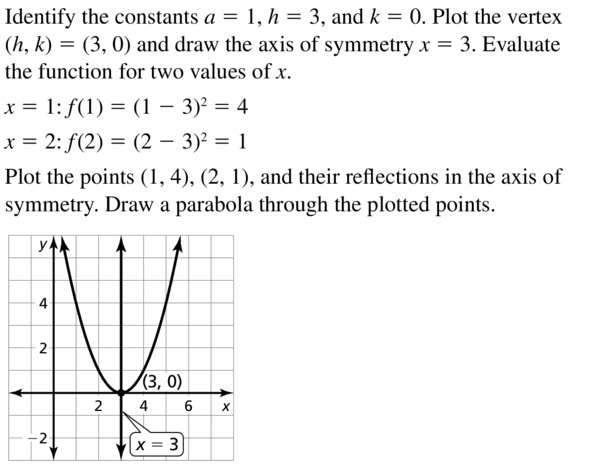
f(x) = (x – 3)2
Answer:
Question 4.
h(x) = (x + iv)ii
Answer:
Question 5.
g(x) = (x + iii)2 + 5
Reply:
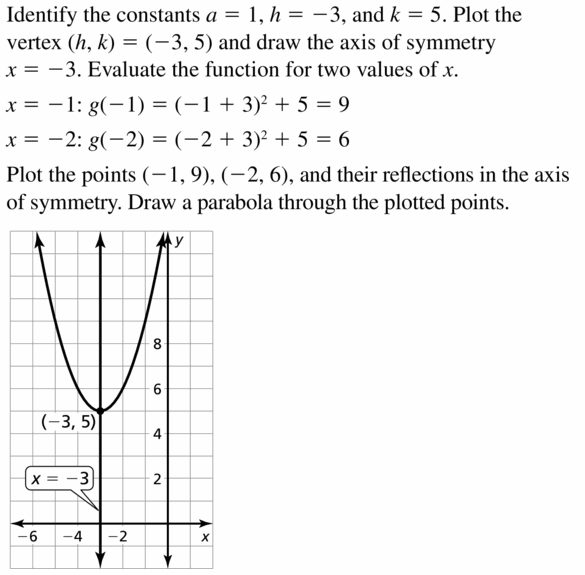
Question 6.
y = (x – 7)2 – 1
Answer:
Question 7.
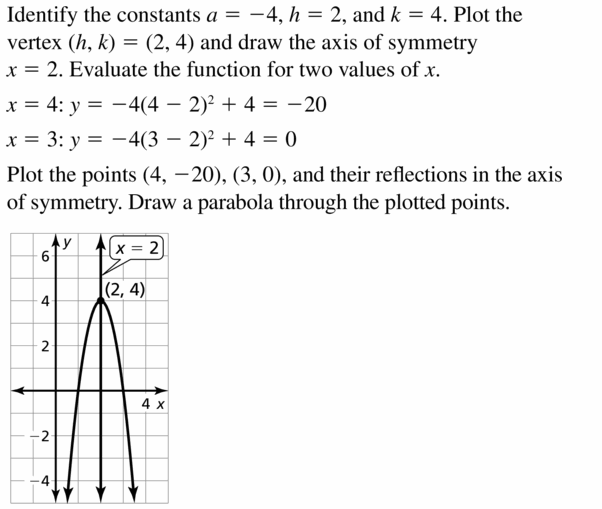
y = -four(x – two)2 + iv
Answer:
Question 8.
thou(x) = 2(ten + 1)2 – three
Reply:
Question ix.
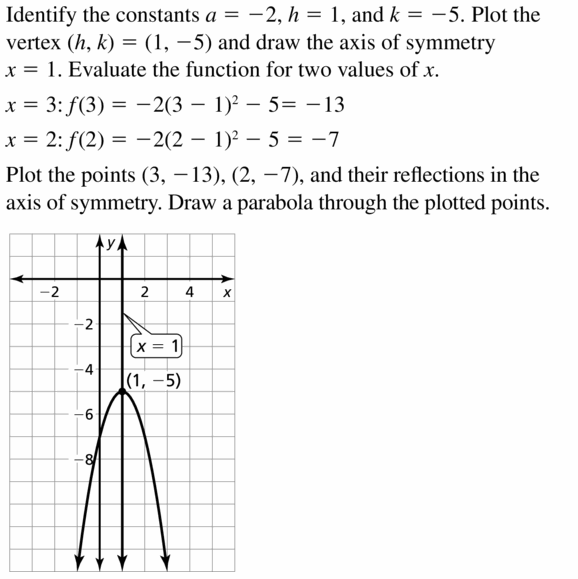
f(x) = -two(x – one)two – 5
Answer:
Question 10.
h(10) = 4(10 + 4)2 + 6
Respond:
Question 11.
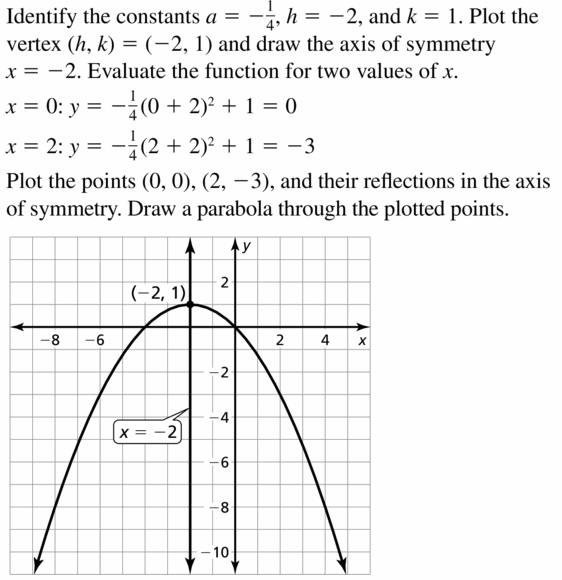
y = –\(\frac{1}{4}\)(x + 2)2 + 1
Answer:
Question 12.
y = \(\frac{one}{2}\)(x – 3)two + 2
Answer:
Question 13.
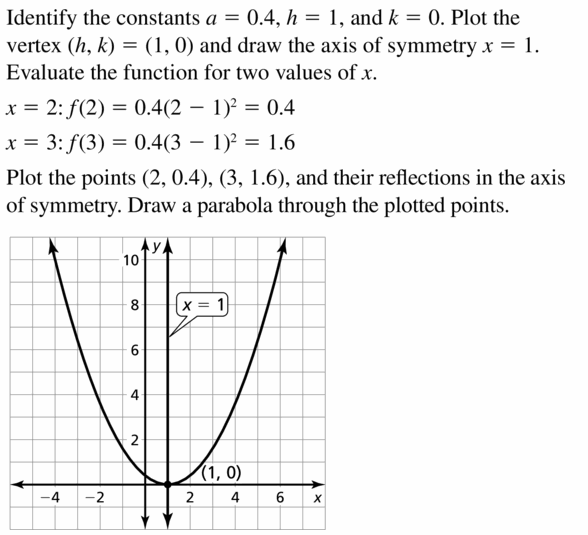
f(x) = 0.4(10 – ane)2
Reply:
Question 14.
one thousand(10) = 0.75x2 – v
Answer:
ANALYZING RELATIONSHIPS In Exercises 15–18, use the axis of symmetry to match the equation with its graph.
Question 15.
y = 2(x – 3)2 + one
Answer:

Question 16.
y = (10 + four)2 – 2
Answer:
Question 17.
y = \(\frac{1}{2}\)(ten + 1)2 + 3
Answer:

Question 18.
y = (x – two)ii – 1
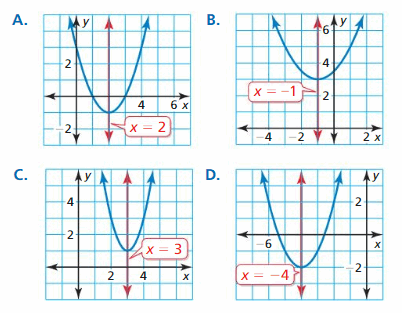
Reply:
REASONING In Exercises 19 and 20, apply the axis of symmetry to plot the reflection of each betoken and complete the parabola.
Question xix.
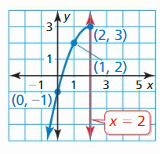
Answer:
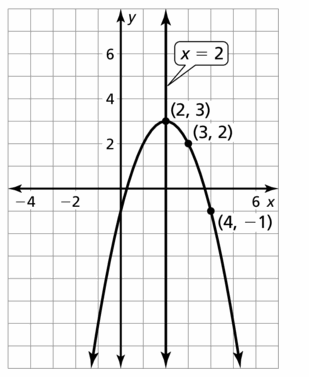
Question 20.
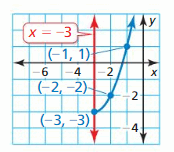
Answer:
In Exercises 21–30, graph the role. Label the vertex and centrality of symmetry.
Question 21.
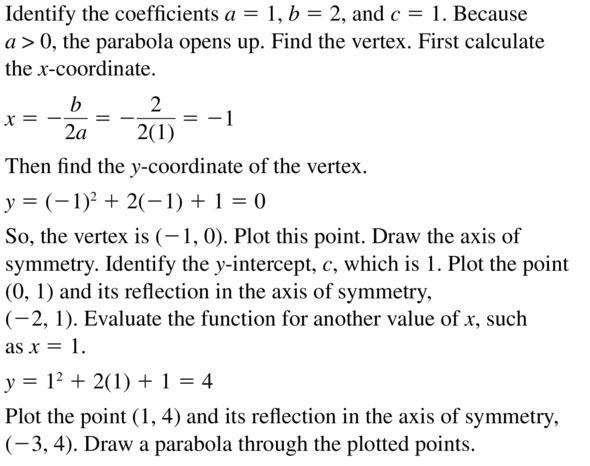
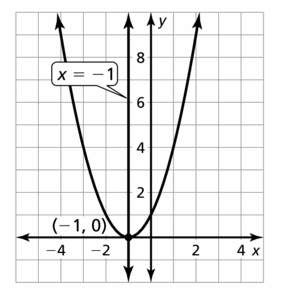
y = x2 + 2x + 1
Respond:
Question 22.
y = 3x2 – 6x + 4
Answer:
Question 23.
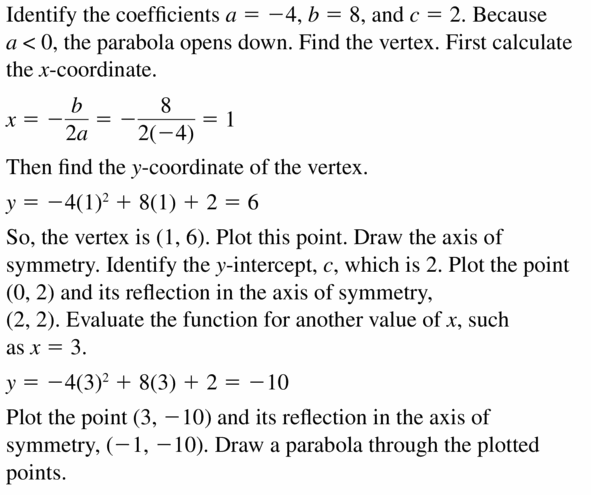
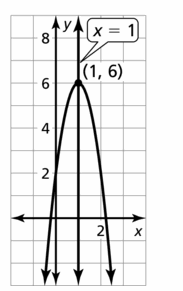
y = -4xii + 8x + 2
Answer:
Question 24.
f(x) = -x2 – 6x + three
Answer:
Question 25.
g(ten) = -x2 – one
Reply:
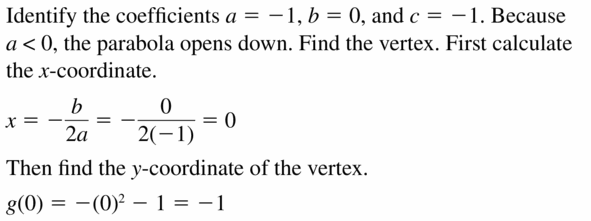
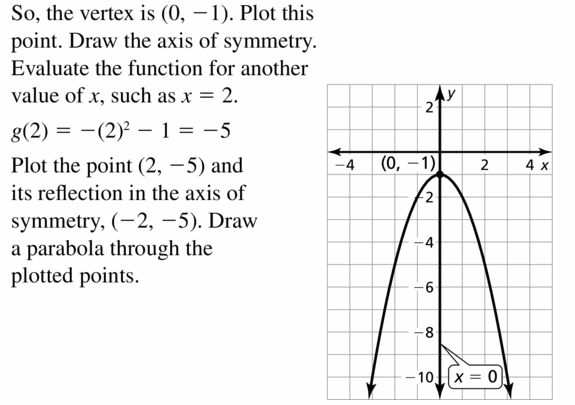
Question 26.
f(x) = 6x2 – five
Answer:
Question 27.
grand(x) = -1.5xii + 3x + 2
Reply:
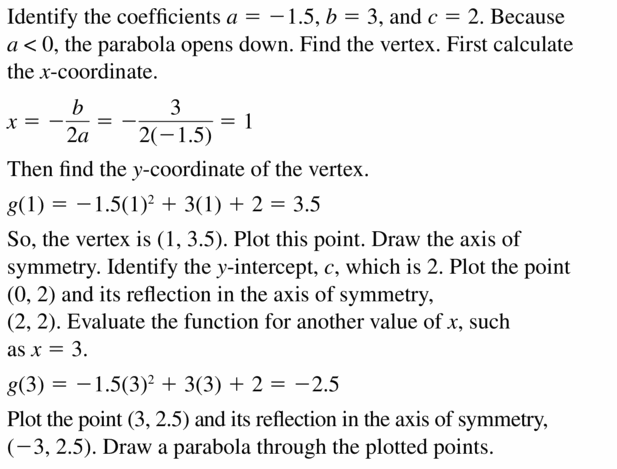
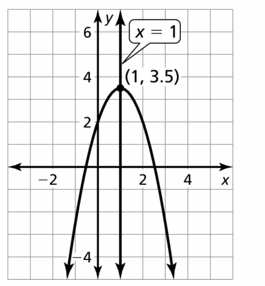
Question 28.
f(x) = 0.5x2 + 10 – 3
Answer:
Question 29.
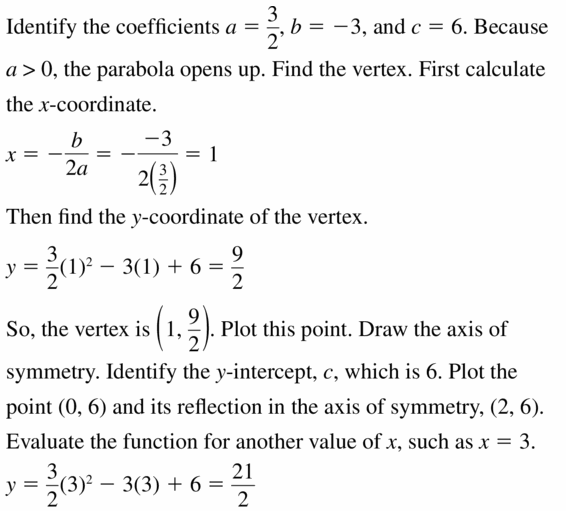
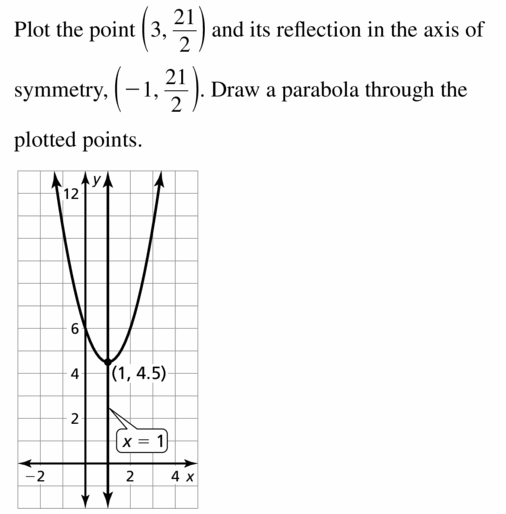
y = \(\frac{3}{2}\)xtwo – 3x + 6
Respond:
Question 30.
y = –\(\frac{5}{2}\)102 – 4x – 1
Respond:
Question 31.
WRITING Two quadratic functions have graphs with vertices (ii, 4) and (ii, -3). Explicate why y'all can not use the axes of symmetry to distinguish between the two functions.
Answer:

Question 32.
WRITING A quadratic part is increasing to the left of x = 2 and decreasing to the right of ten = 2. Will the vertex be the highest or lowest signal on the graph of the parabola? Explicate.
Answer:
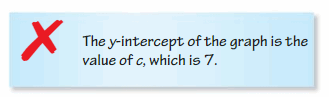
Error Analysis In Exercises 33 and 34, depict and right the error in analyzing the graph of y = 4x2 + 24x − 7.
Question 33.
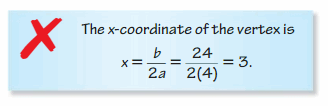
Respond:
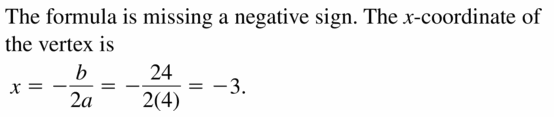
Question 34.
Answer:
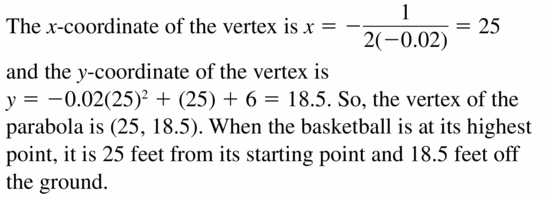
MODELING WITH MATHEMATICS In Exercises 35 and 36, 10 is the horizontal distance (in feet) and y is the vertical altitude (in anxiety). Notice and interpret the coordinates of the vertex.
Question 35.
The path of a basketball thrown at an angle of 45° can be modeled past y = -0.02xii + x + 6.
Answer:
Question 36.
The path of a shot put released at an angle of 35° can be modeled by y = -0.01x2 + 0.7x + vi.
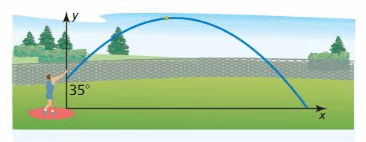
Reply:
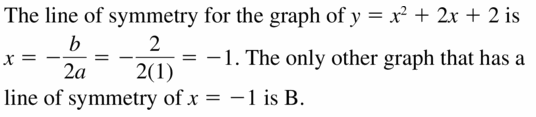
Question 37.
ANALYZING EQUATIONS The graph of which role has the same axis of symmetry as the graph of y = ten2 + 2x + 2?
A. y = 2x2 + 2x + 2
B. y = -3x2 – 6x + two
C. y = x2 – 2x + 2
D. y = -5x2 + 10x + 23
Answer:
Question 38.
USING Construction Which function represents the widest parabola? Explain your reasoning.
A. y = two(x + three)2
B. y = 10two – v
C. y = 0.5(x – 1)2 + 1
D. y = -ten2 + 6
Answer:
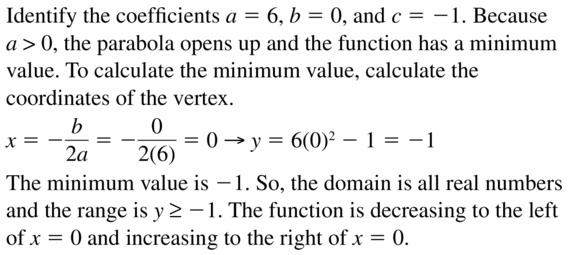
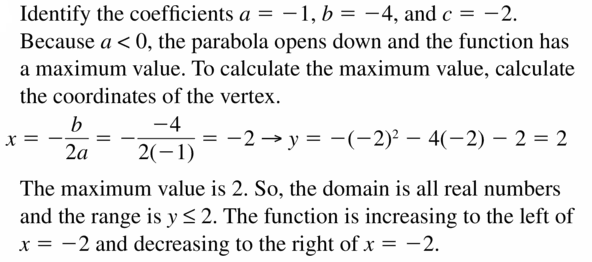
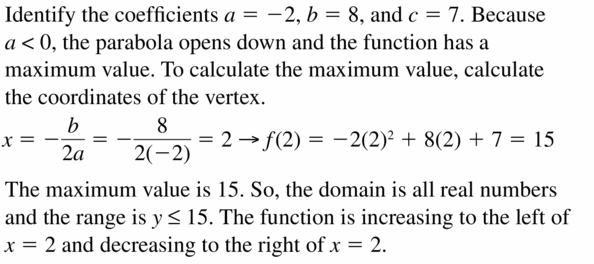
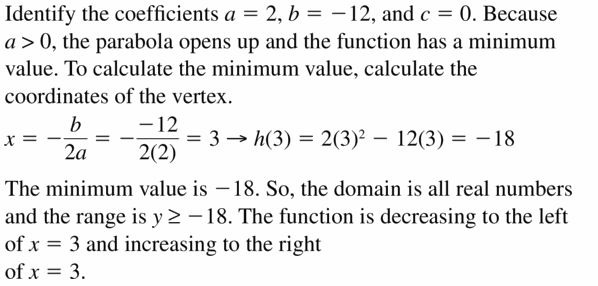
In Exercises 39–48, notice the minimum or maximum value of the function. Describe the domain and range of the office, and where the function is increasing and decreasing.
Question 39.
y = 6x2 – 1
Answer:
Question 40.
y = 9xii + 7
Reply:
Question 41.
y = -102 – 4x – 2
Respond:
Question 42.
thousand(x) = -3xii – 6x + v
Answer:
Question 43.
f(x) = -2xii + 8x + vii
Answer:
Question 44.
g(x) = 3x2 + 18x – 5
Answer:
Question 45.
h(10) = 2xii – 12x
Answer:
Question 46.
h(ten) = 10two – 4x
Respond:
Question 47.
y = \(\frac{ane}{four}\)xii – 3x + 2
Answer:
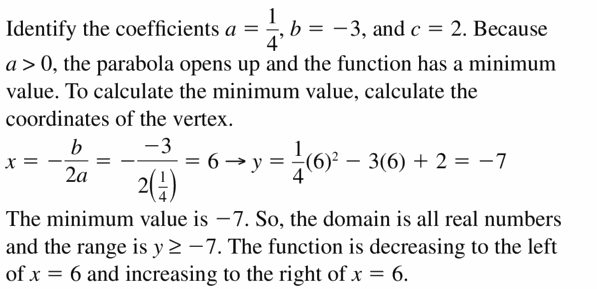
Question 48.
f(x) = \(\frac{3}{2}\)xii + 6x + four
Answer:
Question 49.
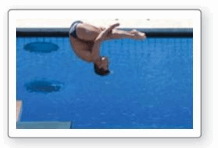
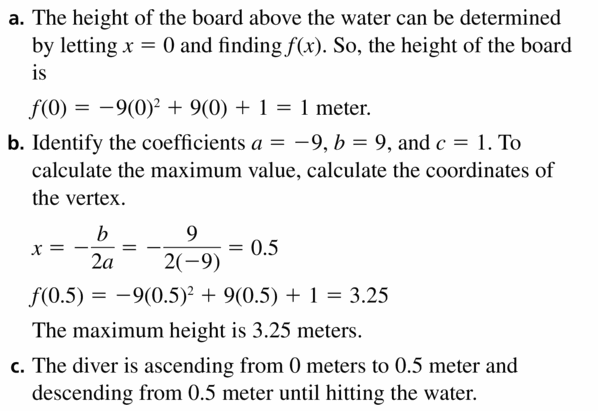
Trouble SOLVING The path of a diver is modeled by the function f(x) = -9xii + 9x + 1, where f(10) is the tiptop of the diver (in meters) above the water and x is the horizontal altitude (in meters) from the cease of the diving board.
a. What is the peak of the diving board?
b. What is the maximum height of the diver?
c. Draw where the diver is ascending and where the diver is descending.
Answer:
Question fifty.
PROBLEM SOLVING The engine torque y (in pes-pounds) of one model of machine is given past y = -iii.75x2 + 23.2x + 38.8, where x is the speed (in thousands of revolutions per minute) of the engine.
a. Detect the engine speed that maximizes torque. What is the maximum torque?
b. Explain what happens to the engine torque every bit the speed of the engine increases.
Answer:
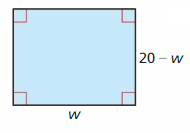
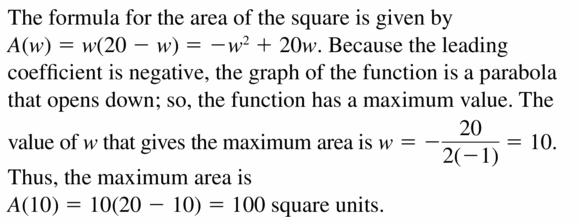
MATHEMATICAL CONNECTIONS In Exercises 51 and 52, write an equation for the area of the figure. Then determine the maximum possible area of the figure.
Question 51.
Reply:
Question 52.
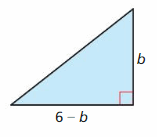
Respond:
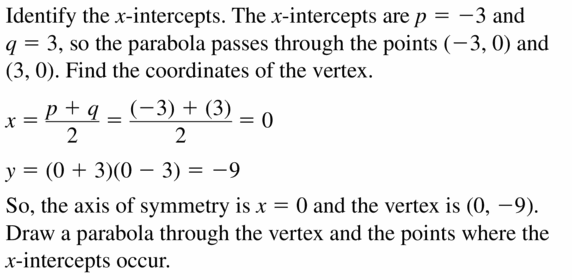
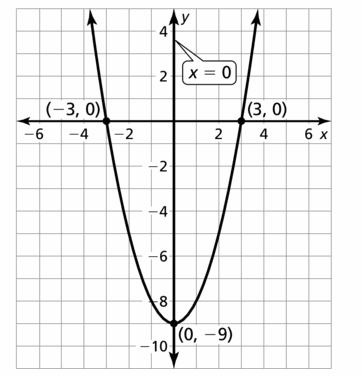
In Exercises 53–60, graph the function. Characterization the x-intercept(s), vertex, and axis of symmetry.
Question 53.
y = (ten + iii)(ten – 3)
Answer:
Question 54.
y = (ten + 1)(x – 3)
Answer:
Question 55.
y = 3(x + 2)(x + 6)
Reply:
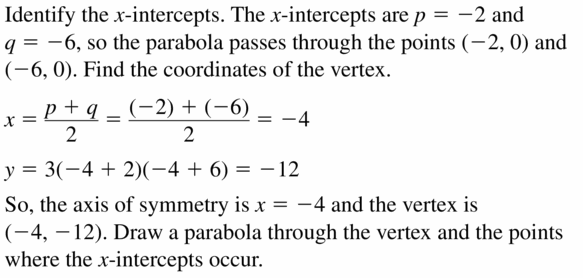
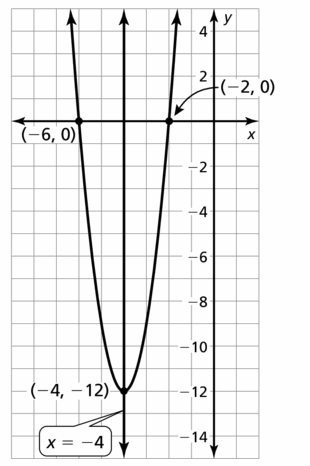
Question 56.
f(x) = 2(10 – v)(ten – ane)
Answer:
Question 57.
m(x) = -x(10 + 6)
Answer:
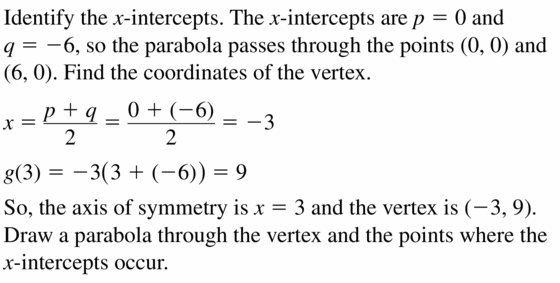
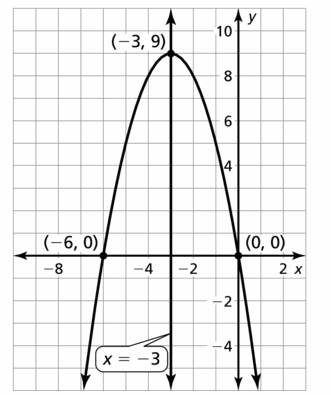
Question 58.
y = -4x(ten + seven)
Answer:
Question 59.
f(x) = -ii(10 – three)2
Respond:
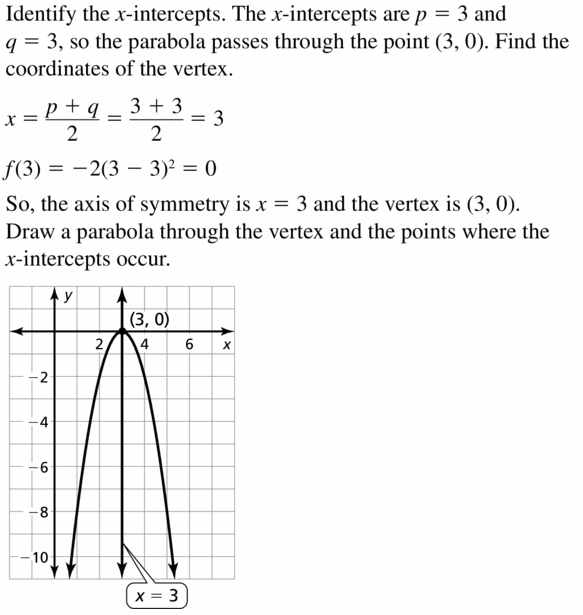
Question 60.
y = 4(x – vii)2
Reply:
USING TOOLS In Exercises 61–64, identify the x-intercepts of the function and describe where the graph is increasing and decreasing. Apply a graphing reckoner to verify your answer.
Question 61.
f(x) = \(\frac{1}{2}\)(x – 2)(x + vi)
Answer:
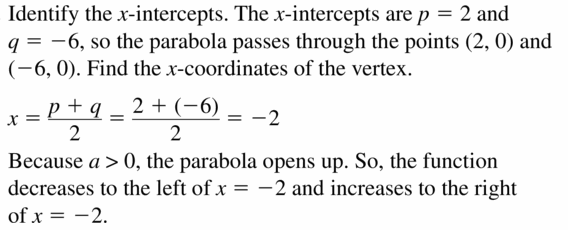
Question 62.
y = \(\frac{iii}{iv}\)(x + one)(ten – three)
Reply:
Question 63.
chiliad(ten) = -four(x – 4)(x – 2)
Respond:
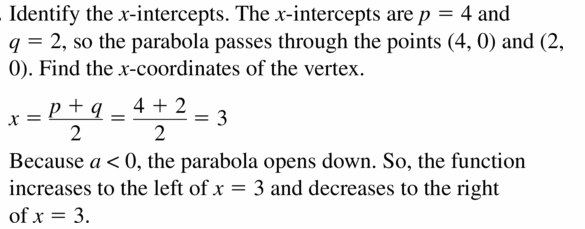
Question 64.
h(ten) = -5(x + v)(x + 1)
Answer:
Question 65.
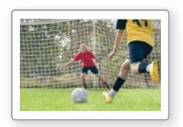
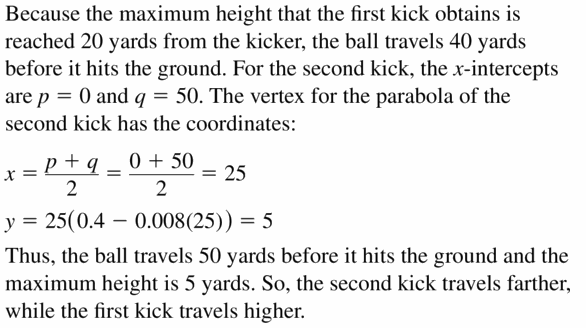
MODELING WITH MATHEMATICS A soccer player kicks a ball downfield. The tiptop of the ball increases until it reaches a maximum height of eight yards, 20 yards abroad from the thespian. A second kick is modeled by y = x(0.4 – 0.008x). Which kick travels further before hitting the ground? Which kick travels higher?
Answer:
Question 66.
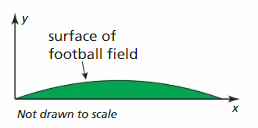
MODELING WITH MATHEMATICS Although a football field appears to exist flat, some are actually shaped like a parabola so that rain runs off to both sides. The cross section of a field tin be modeled past y = -0.000234x(x – 160), where x and y are measured in feet. What is the width of the field? What is the maximum acme of the surface of the field?
Reply:
Question 67.
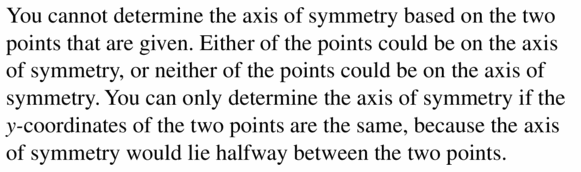
REASONING The points (2, 3) and (-4, 2) prevarication on the graph of a quadratic role. Determine whether you can use these points to observe the axis of symmetry. If non, explicate. If and so, write the equation of the axis of symmetry.
Answer:
Question 68.
OPEN-Ended Write two different quadratic functions in intercept form whose graphs have the axis of symmetry x= 3.
Answer:
Question 69.
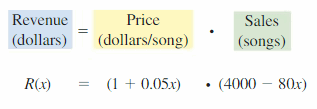
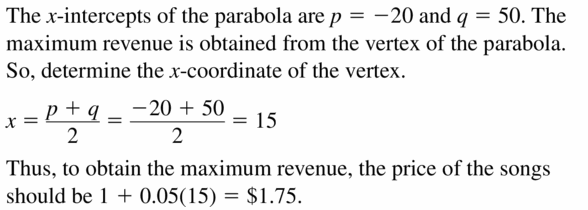
Trouble SOLVING An online music store sells about 4000 songs each mean solar day when it charges $1 per vocal. For each $0.05 increase in toll, about 80 fewer songs per 24-hour interval are sold. Use the verbal model and quadratic function to determine how much the store should charge per song to maximize daily revenue.
Respond:
Question seventy.
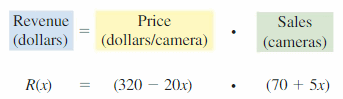
Problem SOLVING An electronics store sells lxx digital cameras per month at a price of $320 each. For each $20 decrease in cost, about 5 more cameras per month are sold. Use the exact model and quadratic office to determine how much the store should charge per camera to maximize monthly revenue.
Answer:
Question 71.
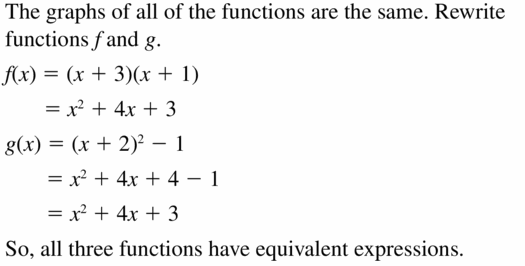
DRAWING CONCLUSIONS Compare the graphs of the three quadratic functions. What exercise you notice? Rewrite the functions f and thou in standard course to justify your answer.
f(x) = (x + 3)(ten + ane)
grand(x) = (ten + 2)2 – 1
h(10) = x2 + 4x + 3
Respond:
Question 72.
USING Construction Write the quadratic function f(ten) = xtwo + x – 12 in intercept form. Graph the function. Label the ten-intercepts, y-intercept, vertex, and axis of symmetry.
Respond:
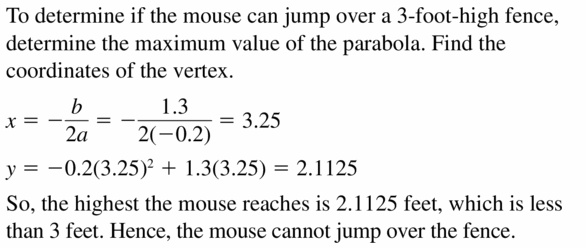
Question 73.
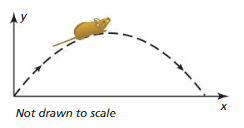
PROBLEM SOLVING A woodland jumping mouse hops forth a parabolic path given by y = -0.2x2 + 1.3x, where x is the mouse's horizontal altitude traveled (in feet) and y is the respective superlative (in feet). Tin can the mouse bound over a argue that is iii feet high? Justify your answer.
Reply:
Question 74.
HOW Do YOU SEE IT? Consider the graph of the function f(x) = a(x – p)(10 – q).
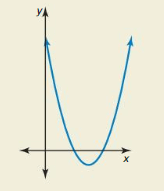
a. What does f(\(\frac{p+q}{two}\)) stand for in the graph?
b. If a < 0, how does your answer in office (a) change? Explain.
Answer:
Question 75.
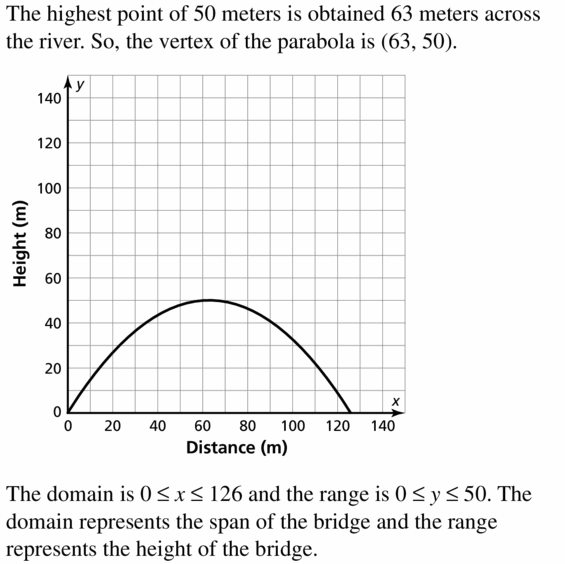
MODELING WITH MATHEMATICS The Gateshead Millennium Bridge spans the River Tyne. The arch of the bridge tin be modeled by a parabola. The arch reaches a maximum height of 50 meters at a signal roughly 63 meters across the river. Graph the bend of the arch. What are the domain and range? What exercise they represent in this state of affairs?

Answer:
Quadratic 76.
THOUGHT PROVOKING
You lot accept 100 anxiety of fencing to enclose a rectangular garden. Draw iii possible designs for the garden. Of these, which has the greatest area? Make a conjecture about the dimensions of the rectangular garden with the greatest possible area. Explicate your reasoning.
Answer:
Question 77.
MAKING AN ARGUMENT The bespeak (i, 5) lies on the graph of a quadratic function with axis of symmetry x = -1. Your friend says the vertex could be the signal (0, 5). Is your friend correct? Explain.
Reply:

Question 78.
Disquisitional THINKING Notice the y-intercept in terms of a, p, and q for the quadratic part f(x) = a(ten – p)(10 – q).
Answer:
Question 79.
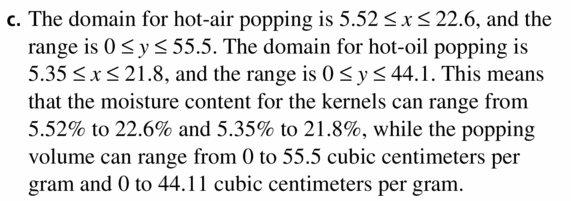
MODELING WITH MATHEMATICS A kernel of popcorn contains water that expands when the kernel is heated, causing information technology to pop. The equations below stand for the "popping volume" y (in cubic centimeters per gram) of popcorn with moisture content x (every bit a percentage of the popcorn'southward weight).
Hot-air popping: y = -0.761(x – five.52)(x – 22.six)
Hot-oil popping:y = -0.652(ten – 5.35)(x – 21.8)

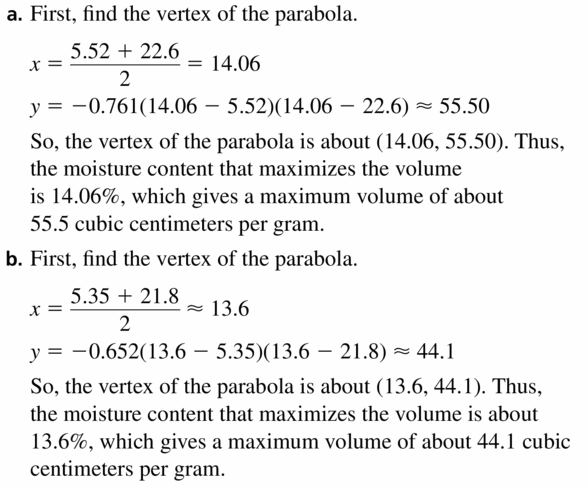
a. For hot-air popping, what moisture content maximizes popping volume? What is the maximum volume?
b. For hot-oil popping, what wet content maximizes popping volume? What is the maximum book?
c. Use a graphing calculator to graph both functions in the same coordinate aeroplane. What are the domain and range of each function in this situation? Explain.
Answer:
Question 80.
Abstruse REASONING A function is written in intercept form with a > 0. What happens to the vertex of the graph as a increases? every bit a approaches 0?
Respond:
Maintaining Mathematical Proficiency
Solve the equation. Check for extraneous solutions. (Skills Review Handbook)
Question 81.
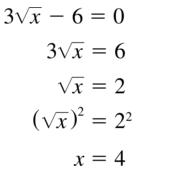
iii\(\sqrt{x}\) – vi = 0
Reply:
Question 82.
two\(\sqrt{10-4}\) – 2 = two
Answer:
Question 83.
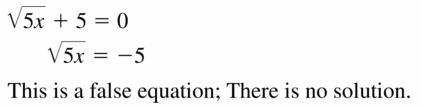
\(\sqrt{5x}\) + 5 = 0
Answer:
Question 84.
\(\sqrt{3x+eight}\) = \(\sqrt{ten+iv}\)
Answer:
Solve the proportion. (Skills Review Handbook)
Question 85.
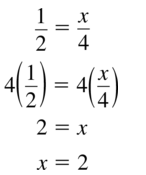
\(\frac{i}{2}\) = \(\frac{ten}{four}\)
Answer:
Question 86.
\(\frac{2}{3}\) = \(\frac{x}{9}\)
Answer:
Question 87.
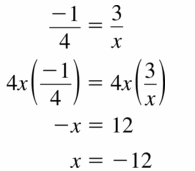
\(\frac{-one}{4}\) = \(\frac{iii}{10}\)
Answer:
Question 88.
\(\frac{5}{ii}\) =-\(\frac{20}{x}\)
Answer:
Quadratic Functions Study Skills Using the Features of Your Textbook to Prepare for Quizzes and Tests
Cadre Vocabulary
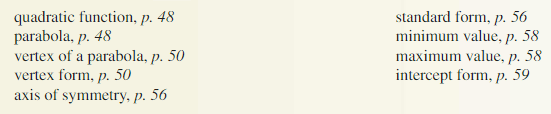
Core Concepts
Section 2.i

Section two.2

Mathematical Practices
Question 1.
Why does the elevation you lot establish in Exercise 44 on page 53 make sense in the context of the situation?
Question 2.
How tin y'all effectively communicate your preference in methods to others in Exercise 47 on folio 54?
Question 3.
How can you lot use technology to deepen your understanding of the concepts in Practice 79 on folio 64?
Study Skills
Using the Features of Your Textbook to Prepare for Quizzes and Tests
- Read and understand the cadre vocabulary and the contents of the Core Concept boxes.
- Review the Examples and the Monitoring Progress questions. Use the tutorials at BigIdeasMath.com for additional help.
- Review previously completed homework assignments.

Quadratic Functions 2.1 – ii.ii Quiz
2.ane – 2.2 Quiz
Draw the transformation of f(10) = x2 represented by g. (Section 2.one)
Question one.
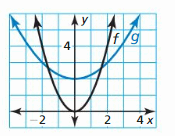
Question 2.
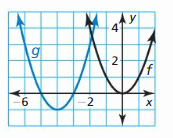
Question three.
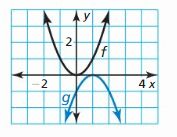
Write a rule for m and identify the vertex. (Section 2.1)
Question 4.
Let g be a translation 2 units up followed by a reflection in the x-axis and a vertical stretch by a gene of half dozen of the graph of f(10) = ten2.
Question 5.
Let g be a translation 1 unit of measurement left and vi units downward, followed by a vertical shrink past a cistron of \(\frac{ane}{two}\) of the graph of f(x) = 3(x + 2)two.
Question 6.
Permit g exist a horizontal shrink by a factor of \(\frac{1}{4}\), followed past a translation i unit up and iii units right of the graph of f(x) = (2x + 1)2 – 11.
Graph the part. Characterization the vertex and axis of symmetry. (Section two.2)
Question 7.
f(x) = 2(x – 1)2 – 5
Question 8.
h(x) = 3xtwo + 6x – two
Question ix.
f(10) = 7 – 8x – x2
Find the x-intercepts of the graph of the function. Then describe where the office is increasing and decreasing.(Section 2.2)
Question 10.
g(x) = -3(x + 2)(x + 4)
Question 11.
k(x) = \(\frac{1}{2}\)(ten – 5)(x + 1)
Question 12.
f(x) = 0.4x(10 – half dozen)
Question 13.
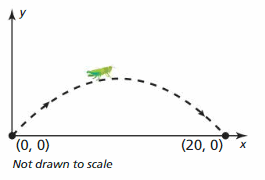
A grasshopper tin leap incredible distances, up to 20 times its length. The height (in inches) of the jump in a higher place the footing of a i-inch-long grasshopper is given by h(x) = –\(\frac{1}{20}\)102 + x, where x is the horizontal distance (in inches) of the leap. When the grasshopper jumps off a rock, it lands on the ground 2 inches farther. Write a function that models the new path of the jump. (Section 2.1)
Question fourteen.
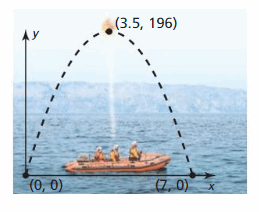
A rider on a stranded lifeboat shoots a distress flare into the air. The height (in anxiety) of the flare above the water is given by f(t) = -16t(t – viii), where t is time (in seconds) since the flare was shot. The passenger shoots a 2nd flare, whose path is modeled in the graph. Which flare travels higher? Which remains in the air longer? Justify your answer. (Section ii.2)
Lesson two.3 Focus of a Parabola
Essential Question
What is the focus of a parabola?
EXPLORATION 1
Analyzing Satellite Dishes
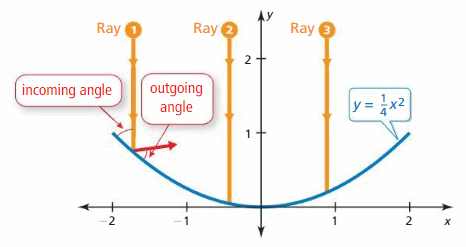
Piece of work with a partner. Vertical rays enter a satellite dish whose cantankerous department is a parabola. When the rays hit the parabola, they reflect at the same angle at which they entered. (Meet Ray one in the figure.)
a. Draw the reflected rays and so that they intersect the y-axis.
b. What do the reflected rays have in mutual?
c. The optimal location for the receiver of the satellite dish is at a betoken called the focus of the parabola. Determine the location of the focus. Explain why this makes sense in this situation.
EXPLORATION 2
Analyzing Spotlights
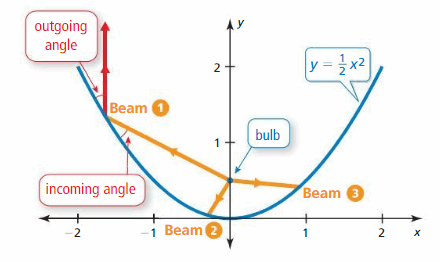
Work with a partner. Beams of light are coming from the seedling in a spotlight, located at the focus of the parabola. When the beams hit the parabola, they reflect at the same bending at which they hitting. (See Beam one in the effigy.) Draw the reflected beams. What do they have in mutual? Would you consider this to exist the optimal event? Explain.
Communicate Your Respond
Question 3.
What is the focus of a parabola?
Question 4.
Describe some of the properties of the focus of a parabola.
two.3 Lesson
Monitoring Progress
Question i.
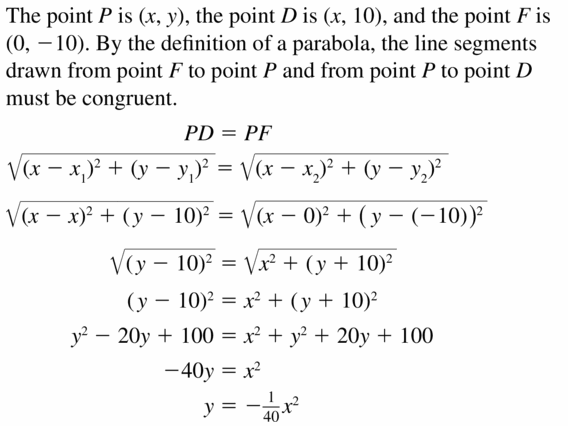
Use the Distance Formula to write an equation of the parabola with focus F(0, -three) and directrix y = three.
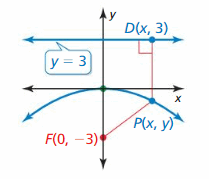
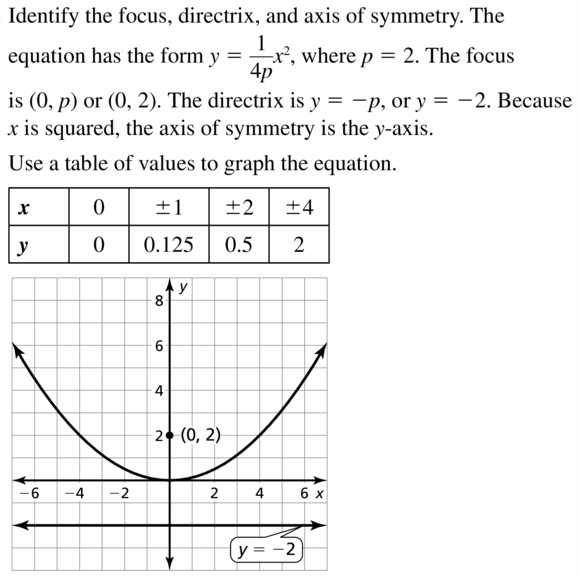
Place the focus, directrix, and axis of symmetry of the parabola. So graph the equation.
Question two.
y = 0.5xii
Question 3.
-y = x2
Question 4.
y2 = 6x
Write an equation of the parabola with vertex at (0, 0) and the given directrix or focus.
Question five.
directrix: x = -3
Question 6.
focus: (-ii, 0)
Question 7.
focus: (0, \(\frac{3}{2}\))
Monitoring Progress
Question 8.
Write an equation of a parabola with vertex (-1, iv) and focus (-1, 2).
Question 9.
A parabolic microwave antenna is 16 anxiety in diameter. Write an equation that represents the cantankerous section of the antenna with its vertex at (0, 0) and its focus 10 feet to the right of the vertex. What is the depth of the antenna?
Focus of a Parabola 2.three Exercises
Vocabulary and Core Concept Check
Question 1.
Consummate THE SENTENCE A parabola is the set of all points in a plane equidistant from a stock-still point called the ______ and a stock-still line chosen the __________ .
Answer:

Question 2.
WRITING Explicate how to notice the coordinates of the focus of a parabola with vertex (0, 0)and directrix y = 5.
Reply:
Monitoring Progress and Modeling with Mathematics
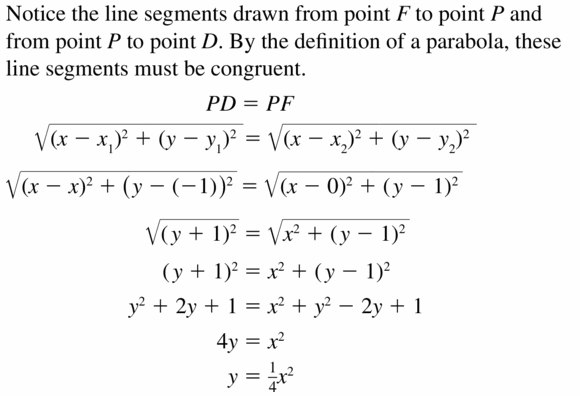
In Exercises iii–10, utilize the Altitude Formula to write an equation of the parabola.
Question iii.
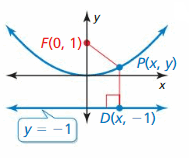
Reply:
Question iv.
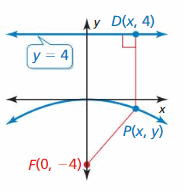
Answer:
Question 5.
focus: (0, -2)
directrix: y = ii
Respond:
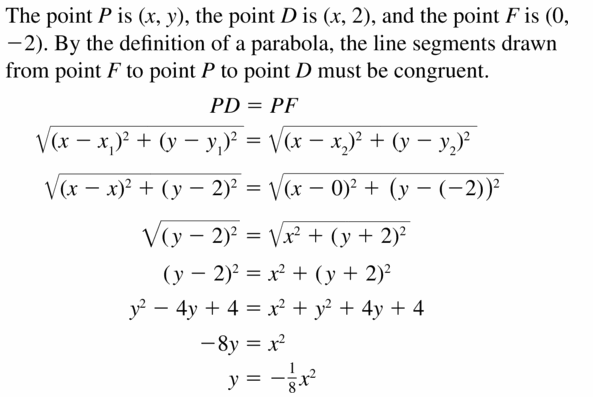
Question 6.
directrix: y = 7
focus: (0, -seven)
Answer:
Question 7.
vertex: (0, 0)
directrix: y = -6
Answer:
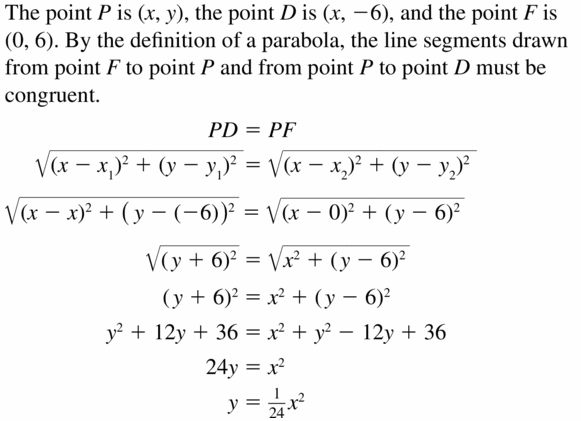
Question 8.
vertex: (0, 0)
focus: (0, five)
Answer:
Question 9.
vertex: (0, 0)
focus: (0, -10)
Answer:
Question 10.
vertex: (0, 0)
directrix: y = -9
Respond:
Question 11.
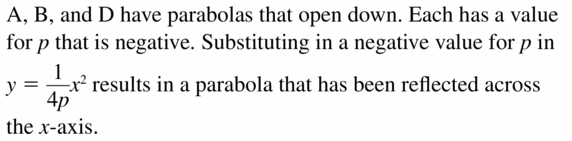
ANALYZING RELATIONSHIPS Which of the given characteristics describe parabolas that open down? Explicate your reasoning.
A. focus: (0, -half dozen)
directrix: y = 6
B. focus: (0, -2)
directrix: y = 2
C.focus: (0, 6)
directrix: y = -6
D. focus: (0, -1)
directrix: y = 1
Reply:
Question 12.
REASONING Which of the following are possible coordinates of the point P in the graph shown? Explain.
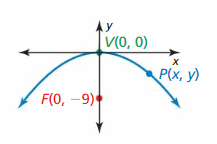
A. (-half-dozen, -1)
B. (iii, –\(\frac{1}{4}\))
C. (4, –\(\frac{four}{9}\))
D. (one, –\(\frac{1}{36}\))
Eastward. (6, -i)
F. (two, –\(\frac{1}{eighteen}\))
Answer:
In Exercises xiii–20, identify the focus, directrix, and axis of symmetry of the parabola. Graph the equation.
Question 13.
y = \(\frac{1}{viii}\)xtwo
Answer:
Question 14.
y = –\(\frac{1}{12}\)ten2
Reply:
Question xv.
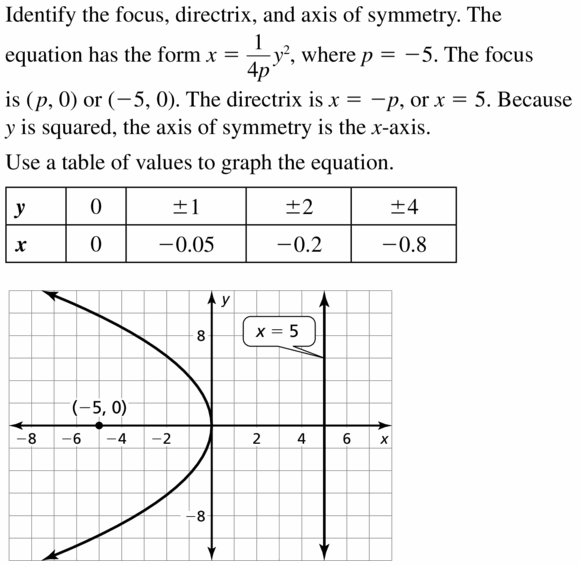
10 = –\(\frac{1}{twenty}\)y2
Answer:
Question 16.
x= \(\frac{one}{24}\)y2
Answer:
Question 17.
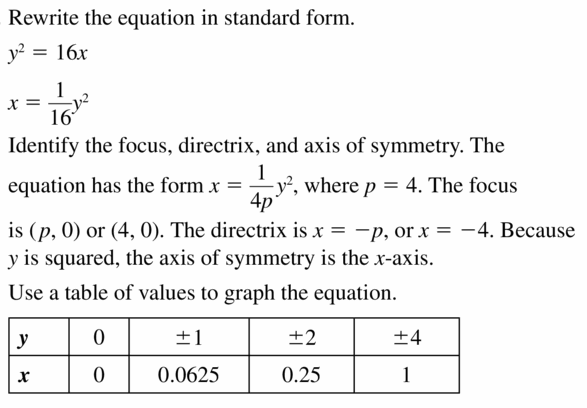
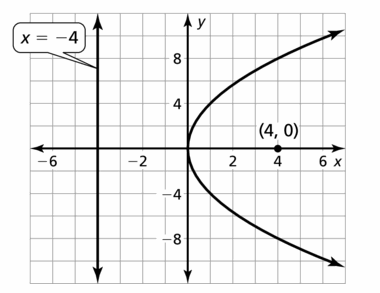
y2 = 16x
Answer:
Question 18.
-x2 = 48y
Answer:
Question 19.
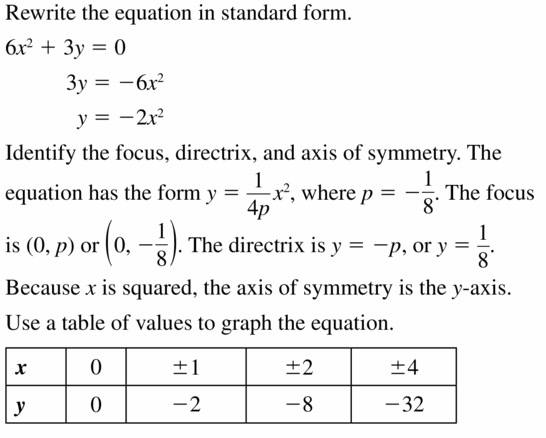
6x2 + 3y = 0
Answer:
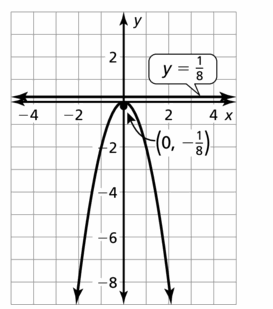
Question 20.
8x2 – y = 0
Answer:
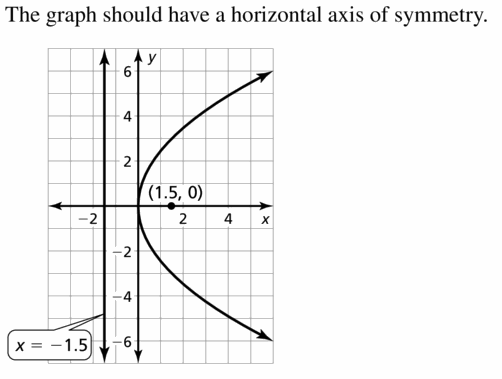
ERROR Assay In Exercises 21 and 22, describe and right the error in graphing the parabola.
Question 21.
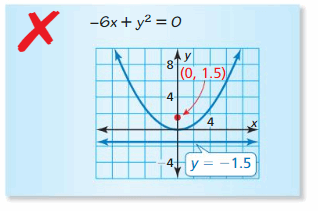
Reply:
Question 22.
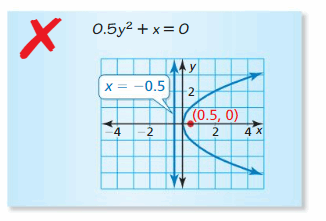
Answer:
Question 23.
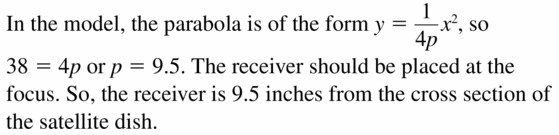
ANALYZING EQUATIONS The cross section (with units in inches) of a parabolic satellite dish can exist modeled by the equation y = \(\frac{1}{38}\)tenii. How far is the receiver from the vertex of the cantankerous section? Explain.
Reply:
Question 24.
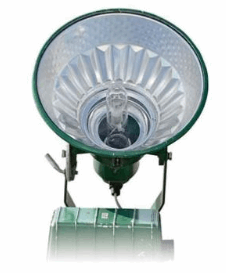
ANALYZING EQUATIONS The cantankerous department (with units in inches) of a parabolic spotlight can be modeled by the equation ten = \(\frac{ane}{20}\)yii. How far is the bulb from the vertex of the cross section? Explain.
Reply:
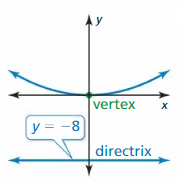
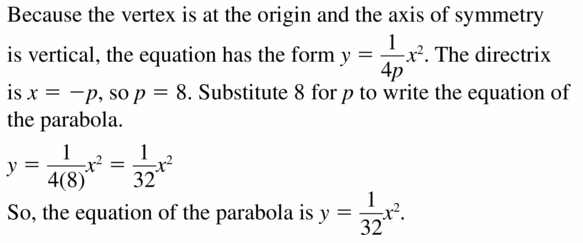
In Exercises 25–28, write an equation of the parabola shown.
Question 25.
Respond:
Question 26.
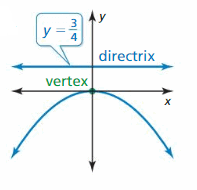
Reply:
Question 27.
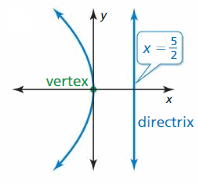
Answer:
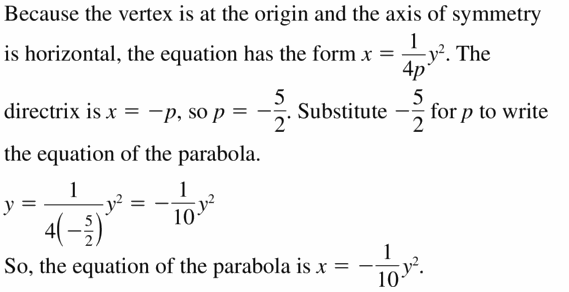
Question 28.
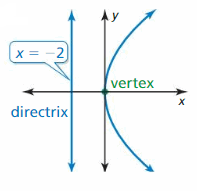
Respond:
In Exercises 29–36, write an equation of the parabola with the given characteristics.
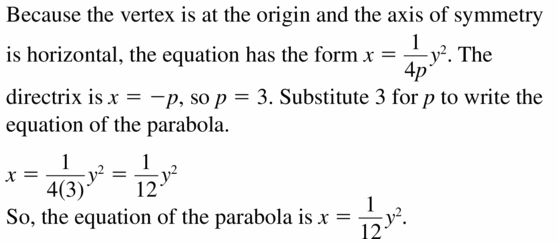
Question 29.
focus: (3, 0)
directrix: x = -3
Answer:
Question 30.
focus: (\(\frac{2}{three}\), 0)
directrix: 10 = –\(\frac{2}{3}\)
Answer:
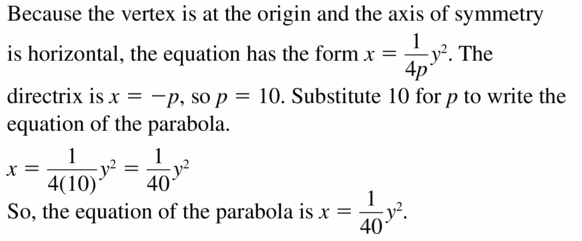
Question 31.
directrix: x = -x
vertex: (0, 0)
Reply:
Question 32.
directrix: y = \(\frac{eight}{iii}\)
vertex: (0, 0)
Answer:
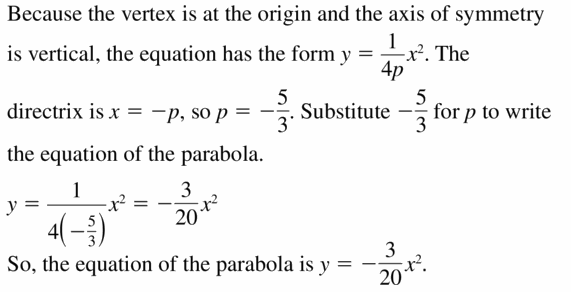
Question 33.
focus: (0, –\(\frac{5}{three}\))
directrix: y = \(\frac{5}{3}\)
Reply:
Question 34.
focus: (0, \(\frac{5}{4}\))
directrix: y = –\(\frac{v}{four}\)
Reply:
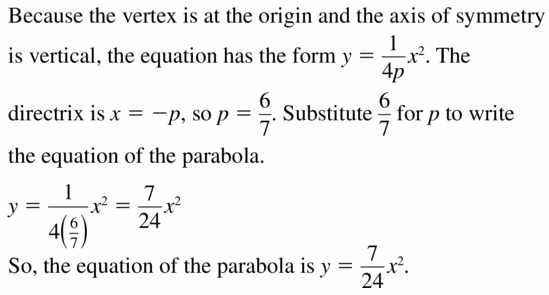
Question 35.
focus: (0, \(\frac{6}{vii}\))
vertex: (0, 0)
Answer:
Question 36.
focus: (-\(\frac{4}{5}\), 0)
vertex: (0, 0)
Respond:
In Exercises 37–40, write an equation of the parabola shown.
Question 37.
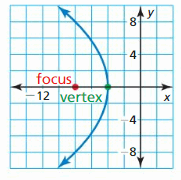
Respond:
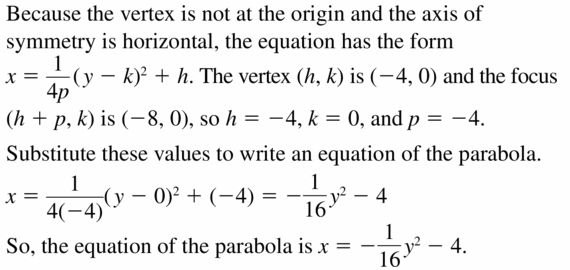
Question 38.
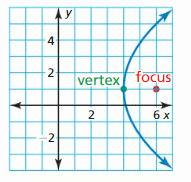
Reply:
Question 39.
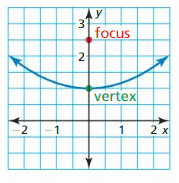
Answer:
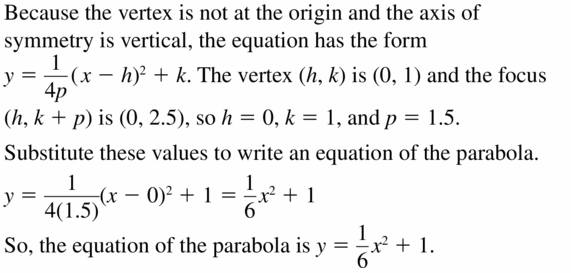
Question 40.
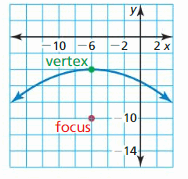
Answer:
In Exercises 41–46, identify the vertex, focus, directrix, and axis of symmetry of the parabola. Draw the transformations of the graph of the standard equation with p = one and vertex (0, 0).
Question 41.
y = \(\frac{1}{eight}\)(x – 3)2 + 2
Answer:
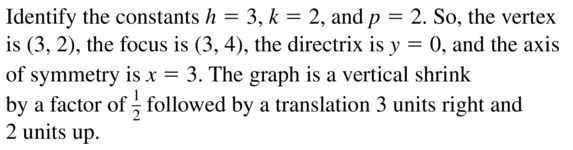
Question 42.
y = –\(\frac{ane}{four}\)(x + ii)ii + 1
Answer:
Question 43.
ten = \(\frac{1}{16}\)(y – 3)2 + 1
Answer:
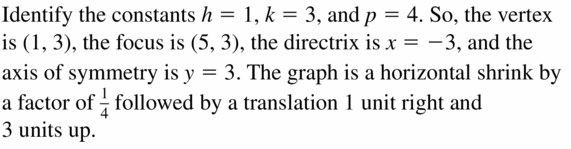
Question 44.
y = (x + iii)two – 5
Reply:
Question 45.
10 = -3(y + 4)2 + 2
Answer:
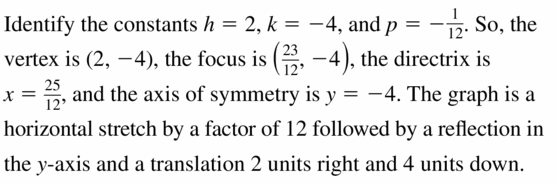
Question 46.
x = 4(y + v)ii – ane
Answer:
Question 47.
MODELING WITH MATHEMATICS Scientists studying dolphin echolocation simulate the projection of a bottlenose dolphin'southward clicking sounds using computer models. The models originate the sounds at the focus of a parabolic reflector. The parabola in the graph shows the cross section of the reflector with focal length of ane.3 inches and aperture width of viii inches. Write an equation to correspond the cross section of the reflector. What is the depth of the reflector?
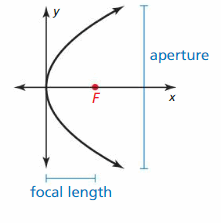
Answer:
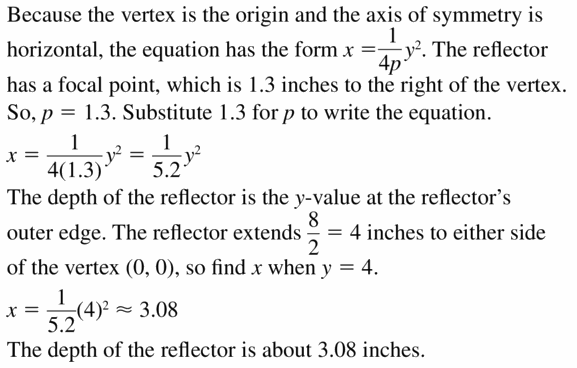
Question 48.
MODELING WITH MATHEMATICS Solar free energy tin can be concentrated using long troughs that have a parabolic cantankerous section as shown in the effigy. Write an equation to represent the cross department of the trough. What are the domain and range in this state of affairs? What exercise they represent?
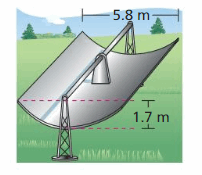
Reply:
Question 49.
Abstract REASONING As | p | increases, how does the width of the graph of the equation y = \(\frac{1}{four p}\)tentwo change? Explain your reasoning.
Answer:

Question l.
HOW DO YOU SEE IT? The graph shows the path of a volleyball served from an initial height of 6 feet as it travels over a internet.
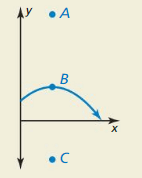
a. Label the vertex, focus, and a point on the directrix.
b. An underhand serve follows the same parabolic path but is hitting from a summit of three anxiety. How does this bear on the focus? the directrix?
Reply:
Question 51.
CRITICAL THINKING The distance from point P to the directrix is 2 units. Write an equation of the parabola.
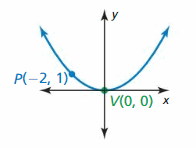
Respond:
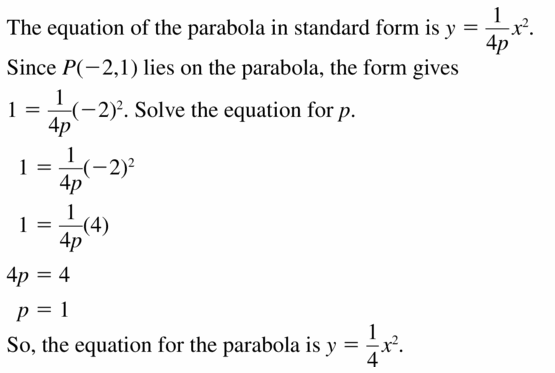
Question 52.
Idea PROVOKING Ii parabolas have the aforementioned focus (a, b) and focal length of ii units. Write an equation of each parabola. Place the directrix of each parabola.
Answer:
Question 53.
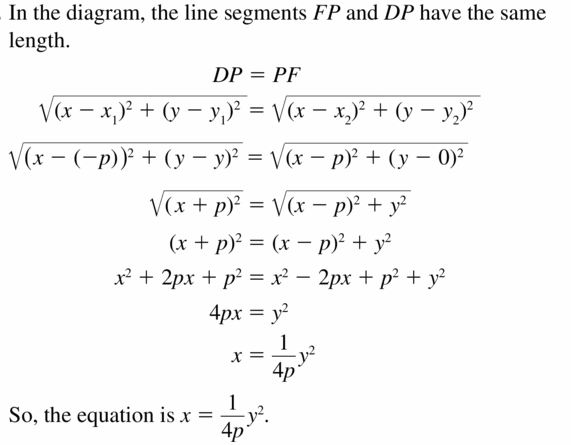
REPEATED REASONING Utilize the Distance Formula to derive the equation of a parabola that opens to the right with vertex (0, 0), focus (p, 0), and directrix x = -p.
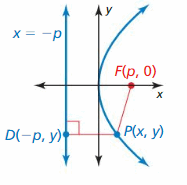
Answer:
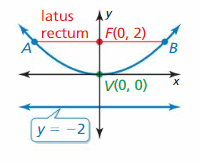
Question 54.
Problem SOLVING The latus rectum of a parabola is the line segment that is parallel to the directrix, passes through the focus, and has endpoints that lie on the parabola. Find the length of the latus rectum of the parabola shown.
Answer:
Maintaining Mathematical Proficiency
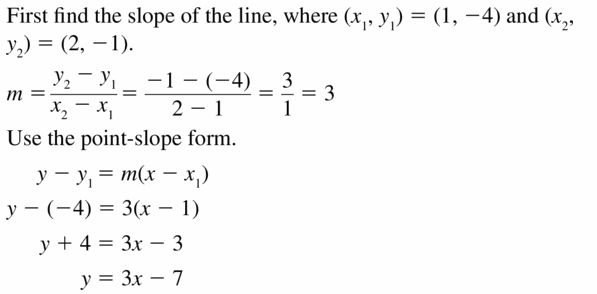
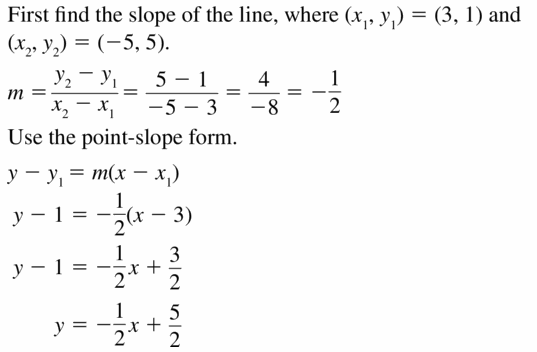
Write an equation of the line that passes through the points.(Section 1.3)
Question 55.
(1, -4), (2, -1)
Answer:
Question 56.
(-3, 12), (0, six)
Answer:
Question 57.
(3, ane), (-5, 5)
Answer:
Question 58.
(2, -1), (0, i)
Respond:
Employ a graphing reckoner to detect an equation for the line of best fit.
Question 59.
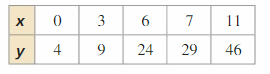
Answer:

Question 60.
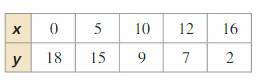
Answer:
Lesson ii.4 Modeling with Quadratic Functions
Essential Question
How can you apply a quadratic role to model a real-life situation?
EXPLORATION 1
Modeling with a Quadratic Function
Piece of work with a partner. The graph shows a quadratic office of the form
P(t) = at2 + bt + c
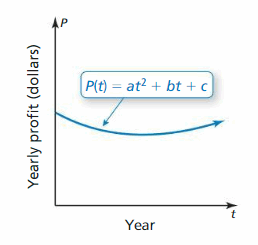
which approximates the yearly profits for a company, where P(t) is the profit in year t.
a. Is the value of a positive, negative, or zippo? Explain.
b. Write an expression in terms of a and b that represents the year t when the company fabricated the least profit.
c. The company fabricated the same yearly profits in 2004 and 2012. Estimate the year in which the company made the least profit.
d. Assume that the model is all the same valid today. Are the yearly profits currently increasing, decreasing, or constant? Explain.
EXPLORATION 2
Modeling with a Graphing Figurer
Work with a partner. The table shows the heights h (in anxiety) of a wrench t seconds afterward it has been dropped from a building under construction.
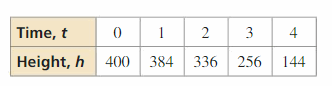
a. Apply a graphing calculator to create a scatter plot of the information, as shown at the correct. Explain why the data appear to fit a quadratic model.
b. Employ the quadratic regression feature to find a quadratic model for the data.
c. Graph the quadratic part on the same screen as the besprinkle plot to verify that it fits the information.
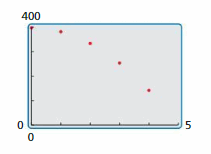
d. When does the wrench striking the ground? Explain.
Communicate Your Reply
Question three.
How can you use a quadratic function to model a existent-life state of affairs?
Question 4.
Use the Cyberspace or another reference to find examples of real-life situations that can be modeled by quadratic functions.
two.4 Lesson
Monitoring Progress
Question ane.
WHAT IF? The vertex of the parabola is (50, 37.5). What is the height of the net?
Question two.
Write an equation of the parabola that passes through the signal (-1, 2) and has vertex (4, -9).
Question 3.
WHAT IF? The y-intercept is 4.8. How does this change your answers in parts (a) and (b)?
Question 4.
Write an equation of the parabola that passes through the point (ii, 5) and has ten-intercepts -2 and 4.
Question five.
Write an equation of the parabola that passes through the points (-one, 4), (0, 1), and (2, 7).
Question half-dozen.
The table shows the estimated profits y (in dollars) for a concert when the charge is x dollars per ticket. Write and evaluate a function to decide what the accuse per ticket should be to maximize the profit.

Question 7.
The tabular array shows the results of an experiment testing the maximum weights y (in tons) supported by water ice x inches thick. Write a office that models the data. How much weight can be supported by water ice that is 22 inches thick?

Modeling with Quadratic Functions 2.4 Exercises
Vocabulary and Core Concept Cheque
Question ane.
WRITING Explain when information technology is advisable to use a quadratic model for a gear up of data.
Answer:

Question two.
DIFFERENT WORDS, SAME QUESTION
Which is dissimilar? Find "both" answers.
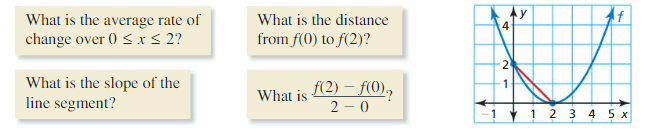
Respond:
Monitoring Progress and Modeling with Mathematics
In Exercises three–8, write an equation of the parabola in vertex grade.
Question iii.
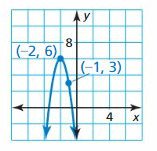
Answer:
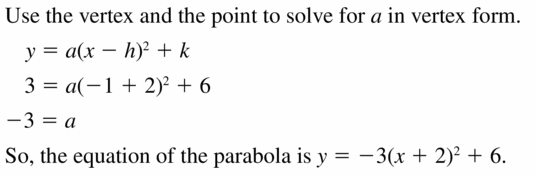
Question 4.
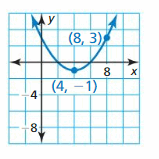
Answer:
Question five.
passes through (xiii, 8) and has vertex (iii, 2)
Respond:
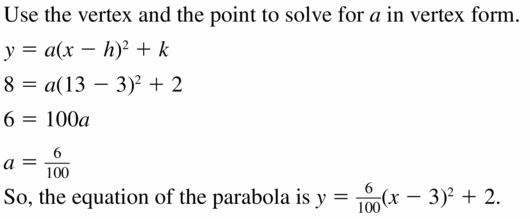
Question 6.
passes through (-7, -xv) and has vertex (-5, nine)
Reply:
Question 7.
passes through (0, -24) and has vertex (-vi, -12)
Reply:
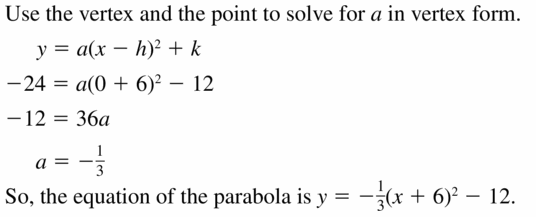
Question viii.
passes through (half dozen, 35) and has vertex (-one, xiv)
Reply:
In Exercises 9–14, write an equation of the parabola in intercept form.
Question nine.
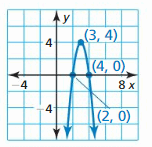
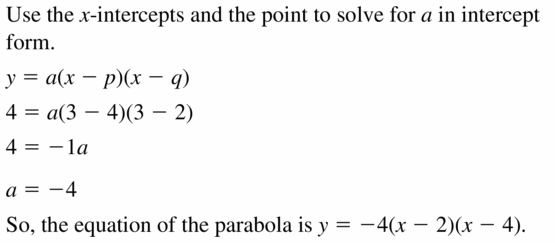
Answer:
Question ten.
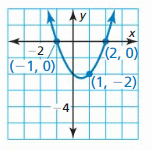
Respond:
Question 11.
x-intercepts of 12 and -6; passes through (14, 4)
Answer:
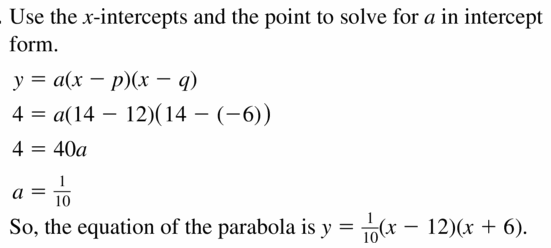
Question 12.
x-intercepts of 9 and i; passes through (0, -18)
Answer:
Question 13.
x-intercepts of -16 and -2; passes through (-18, 72)
Answer:
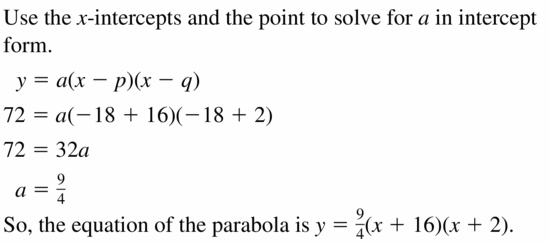
Question 14.
x-intercepts of -seven and -three; passes through (-2, 0.05)
Reply:
Question 15.
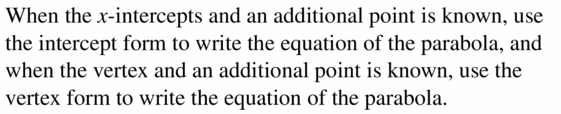
WRITING Explain when to use intercept form and when to use vertex form when writing an equation of a parabola.
Answer:
Question 16.
ANALYZING EQUATIONS Which of the following equations correspond the parabola?
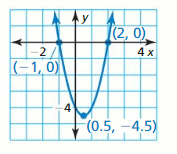
A. y = 2(10 – two)(10 + 1)
B. y = ii(10 + 0.5)2 – 4.5
C. y = 2(x – 0.5)2 – 4.5
D. y = 2(10 + 2)(x – one)
Reply:
In Exercises 17–twenty, write an equation of the parabola in vertex grade or intercept form.
Question 17.
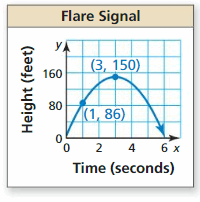
Answer:
Question 18.
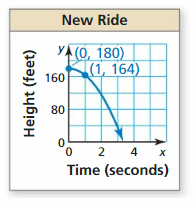
Answer:
Question 19.
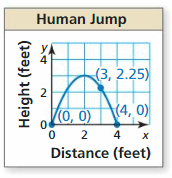
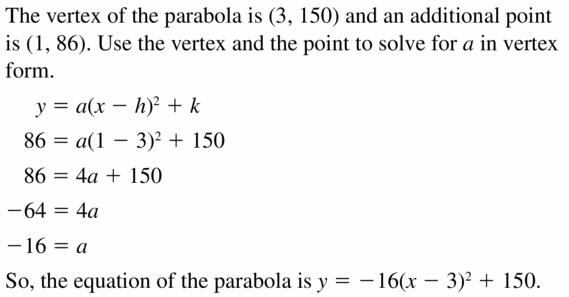
Answer:
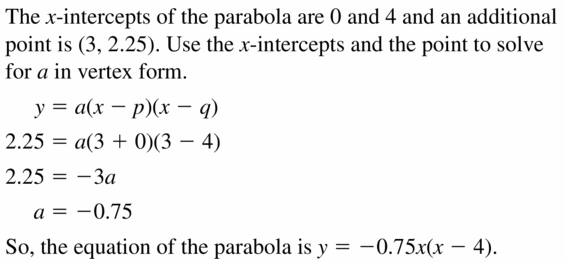
Question twenty.
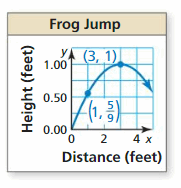
Answer:
Question 21.
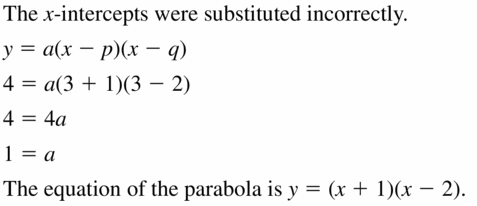
Fault Assay Depict and correct the error in writing an equation of the parabola.
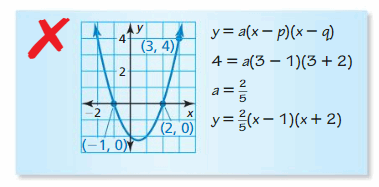
Answer:
Question 22.
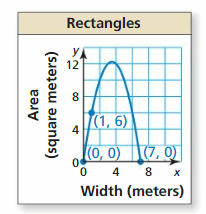
MATHEMATICAL CONNECTIONS The area of a rectangle is modeled by the graph where y is the area (in square meters) and x is the width (in meters). Write an equation of the parabola. Find the dimensions and respective area of one possible rectangle. What dimensions result in the maximum area?
Reply:
Question 23.
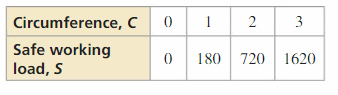
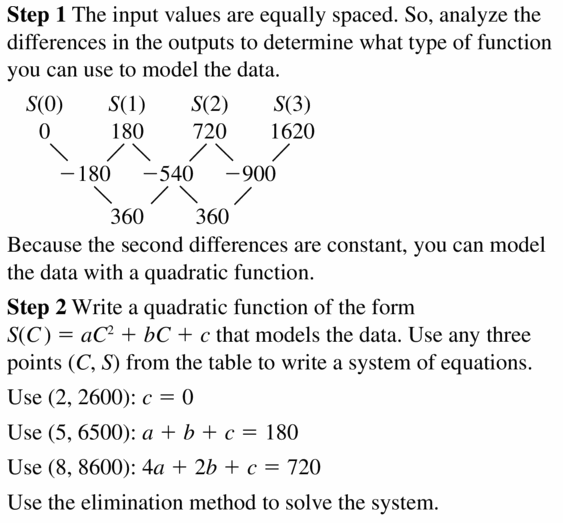
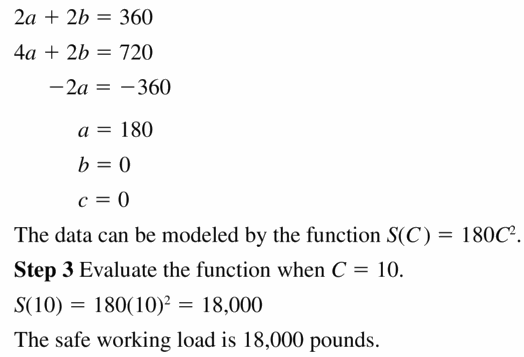
MODELING WITH MATHEMATICS Every rope has a safety working load. A rope should not be used to lift a weight greater than its safe working load. The tabular array shows the safe working loads Due south (in pounds) for ropes with circumference C (in inches). Write an equation for the safe working load for a rope. Observe the condom working load for a rope that has a circumference of 10 inches.
Answer:
Question 24.
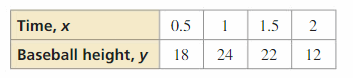
MODELING WITH MATHEMATICS A baseball game is thrown up in the air. The table shows the heights y (in feet) of the baseball afterward ten seconds. Write an equation for the path of the baseball game. Detect the height of the baseball game after 1.7 seconds.
Answer:
Question 25.
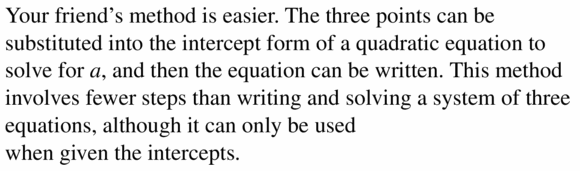
COMPARING METHODS You use a system with three variables to find the equation of a parabola that passes through the points (−8, 0), (two, −twenty), and (1, 0). Your friend uses intercept grade to find the equation. Whose method is easier? Justify your answer.
Answer:
Question 26.
MODELING WITH MATHEMATICS The table shows the distances y a motorcyclist is from home after x hours.
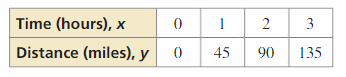
a. Determine what blazon of function you can use to model the information. Explain your reasoning.
b. Write and evaluate a role to determine the altitude the motorcyclist is from home after 6 hours.
Answer:
Question 27.
USING TOOLS The table shows the heights h (in feet) of a sponge t seconds after it was dropped by a window cleaner on acme of a skyscraper.
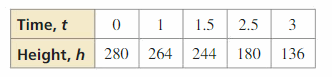
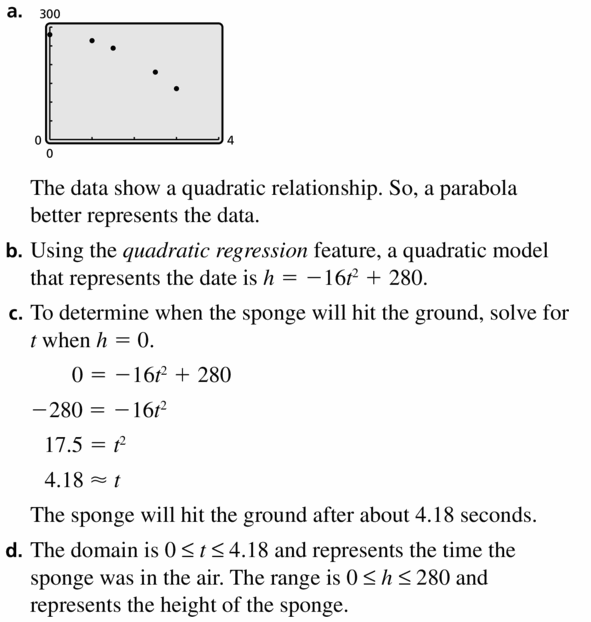
a. Apply a graphing computer to create a scatter plot. Which improve represents the information, a line or a parabola? Explain.
b. Apply the regression characteristic of your calculator to find the model that best fits the data.
c. Use the model in part (b) to predict when the sponge will hitting the ground.
d. Place and interpret the domain and range in this state of affairs.
Answer:
Question 28.
MAKING AN Argument Your friend states that quadratic functions with the same 10-intercepts accept the aforementioned equations, vertex, and axis of symmetry. Is your friend correct? Explicate your reasoning.
Answer:
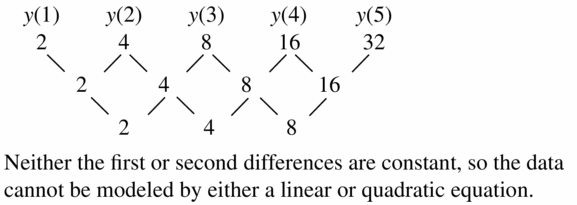
In Exercises 29–32, analyze the differences in the outputs to decide whether the data are linear, quadratic, or neither. Explain. If linear or quadratic, write an equation that fits the information.
Question 29.
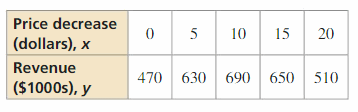
Answer:
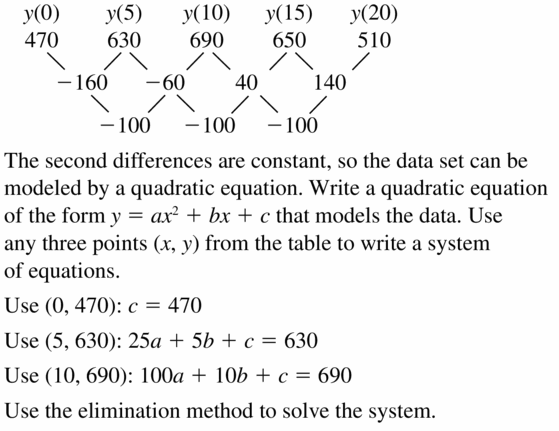
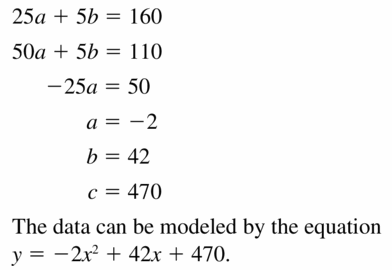
Question 30.
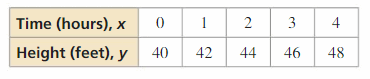
Answer:
Question 31.
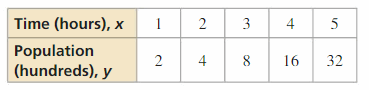
Answer:
Question 32.
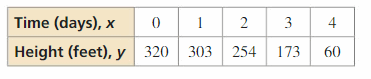
Respond:
Question 33.
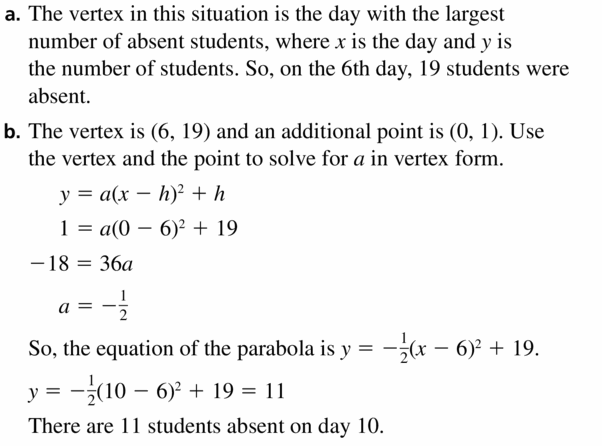
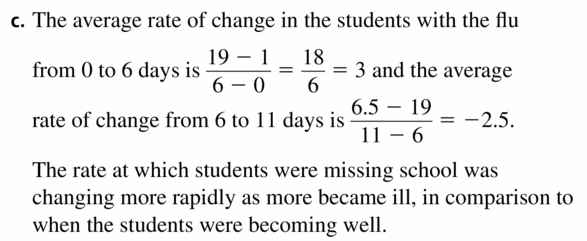
PROBLEM SOLVING The graph shows the number y of students absent from schoolhouse due to the influenza each day 10.
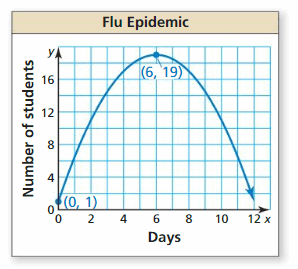
a. Interpret the meaning of the vertex in this situation.
b. Write an equation for the parabola to predict the number of students absent on day 10.
c. Compare the boilerplate rates of change in the students with the flu from 0 to six days and half dozen to 11 days.
Reply:
Question 34.
Idea PROVOKING Describe a real-life situation that can be modeled past a quadratic equation. Justify your answer.
Respond:
Question 35.
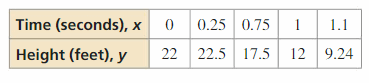
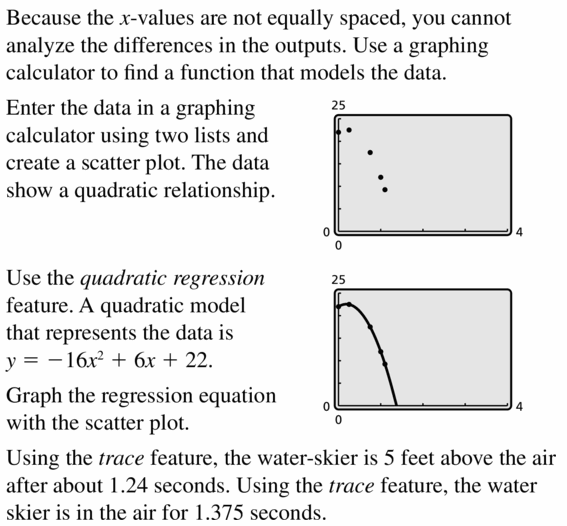
Problem SOLVING The table shows the heights y of a competitive water-skier 10 seconds after jumping off a ramp. Write a part that models the meridian of the water-skier over fourth dimension. When is the h2o-skier five anxiety above the h2o? How long is the skier in the air?
Answer:
Question 36.
HOW DO Yous SEE IT? Use the graph to determine whether the average rate of change over each interval is positive, negative, or zero.
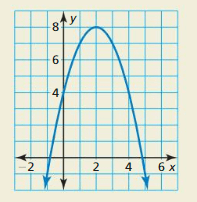
a. 0 ≤ x ≤ 2
b. ii ≤ ten ≤ five
c. 2 ≤ x ≤ 4
d. 0 ≤ ten ≤ 4
Answer:
Question 37.
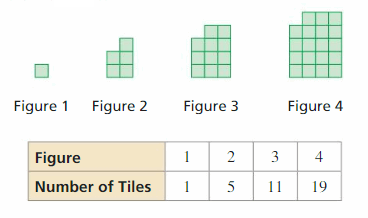
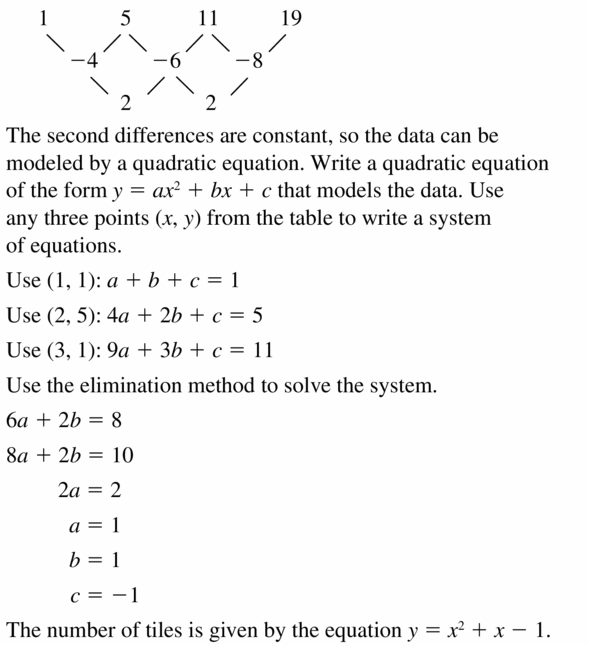
REPEATED REASONING The table shows the number of tiles in each effigy. Verify that the information show a quadratic relationship. Predict the number of tiles in the 12th figure.
Answer:

Maintaining Mathematical Proficiency
Gene the trinomial. (Skills Review Handbook)
Question 38.
x2 + 4x + three
Reply:
Question 39.
x2 – 3x + two
Respond:

Question twoscore.
3x2 – 15x + 12
Answer:
Question 41.
5x2 + 5x – 30
Reply:

Quadratic Functions Performance Task: Accident Reconstruction
2.3–2.iv What Did You Learn?
Core Vocabulary
focus, p. 68
directrix, p. 68
Core Concepts
Section 2.3
Standard Equations of a Parabola with Vertex at the Origin, p. 69
Standard Equations of a Parabola with Vertex at (h, k), p. lxx
Section ii.4
Writing Quadratic Equations, p. 76
Writing Quadratic Equations to Model Data, p. 78
Mathematical Practices
Question ane.
Explicate the solution pathway you used to solve Exercise 47 on page 73.
Question 2.
Explicate how you used definitions to derive the equation in Exercise 53 on page 74.
Question 3.
Explain the shortcut yous found to write the equation in Do 25 on page 81.
Question 4.
Describe how you lot were able to construct a feasible argument in Exercise 28 on page 81.
Performance Chore
Accident Reconstruction
Was the driver of a car speeding when the brakes were practical? What practise skid marks at the scene of an accident reveal most the moments earlier the collision?

To explore the answers to these questions and more, go to BigIdeasMath.com.
Quadratic Functions Affiliate Review
Describe the transformation of f(x) = tenii represented past g. Then graph each part.
Question ane.
yard(x) = (x + four)2
Question 2.
thou(x) = (ten – seven)2 + 2
Question 3.
g(x) = -3(ten + ii)2 – 1
Question four.
Permit the graph of m be a horizontal shrink by a cistron of \(\frac{ii}{3}\), followed by a translation 5 units left and 2 units down of the graph of f(10) = xtwo.
Question v.
Let the graph of thou be a translation ii units left and 3 units up, followed by a reflection in the y-axis of the graph of f(x) = xtwo – 2x.
Graph the function. Label the vertex and centrality of symmetry. Observe the minimum or maximum value of f. Describe where the function is increasing and decreasing.
Question six.
f(x) = 3(x – i)2 – iv
Question vii.
g(x) = -2xtwo + 16x + 3
Question 8.
h(x) = (10 – 3)(10 + seven)
Question 9.
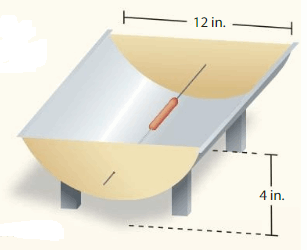
You lot can make a solar hot-dog cooker by shaping foil-lined cardboard into a parabolic trough and passing a wire through the focus of each stop piece. For the trough shown, how far from the lesser should the wire be placed?
Question ten.
Graph the equation 36y = x2. Place the focus, directrix, and axis of symmetry.
Write an equation of the parabola with the given characteristics.
Question eleven.
vertex: (0, 0)
directrix: ten = two
Question 12.
focus: (2, 2)
vertex: (ii, 6)
Write an equation for the parabola with the given characteristics.
Question thirteen.
passes through (1, 12) and has vertex (x, -4)
Question 14.
passes through (4, three) and has x-intercepts of -one and 5
Question 15.
passes through (-ii, seven), (1, 10), and (two, 27)
Question 16.
The tabular array shows the heights y of a dropped object after ten seconds. Verify that the data evidence a quadratic relationship. Write a part that models the data. How long is the object in the air?

Quadratic Functions Affiliate Test
Question 1.
A parabola has an axis of symmetry y= 3 and passes through the indicate (2, one). Find another point that lies on the graph of the parabola. Explain your reasoning.
Question two.
Let the graph of thou be a translation ii units left and i unit down, followed by a reflection in the y-axis of the graph of f(x) = (2x + 1)2 – iv. Write a rule for g.
Question iii.
Identify the focus, directrix, and centrality of symmetry of x = 2y2. Graph the equation.
Question 4.
Explain why a quadratic function models the data. Then use a linear system to notice the model.
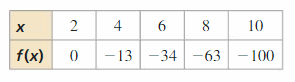
Write an equation of the parabola. Justify your answer.
Question v.
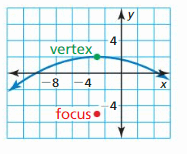
Question vi.
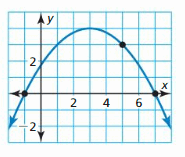
Question vii.
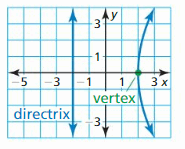
Question eight.
A surfboard shop sells 40 surfboards per calendar month when it charges $500 per surfboard. Each time the store decreases the price past $10, it sells ane additional surfboard per calendar month. How much should the store charge per surfboard to maximize the corporeality of coin earned? What is the maximum amount the shop can earn per month? Explicate.
Question ix.
Graph f(x) = 8xtwo – 4x+ iii. Characterization the vertex and axis of symmetry. Describe where the office is increasing and decreasing.
Question 10.
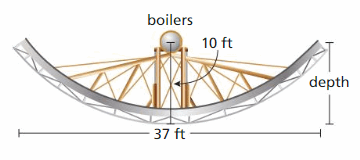
Sunfire is a machine with a parabolic cross department used to collect solar energy. The Dominicus'southward rays are reflected from the mirrors toward ii boilers located at the focus of the parabola. The boilers produce steam that powers an alternator to produce electricity.
a. Write an equation that represents the cross department of the dish shown with its vertex at (0, 0).
b. What is the depth of Sunfire? Justify your answer.
Question 11.
In 2011, the price of gold reached an best loftier. The tabular array shows the prices (in dollars per troy ounce) of gold each year since 2006 (t = 0 represents 2006). Discover a quadratic office that best models the data. Use the model to predict the cost of golden in the year 2016.

Quadratic Functions Cumulative Cess
Question one.
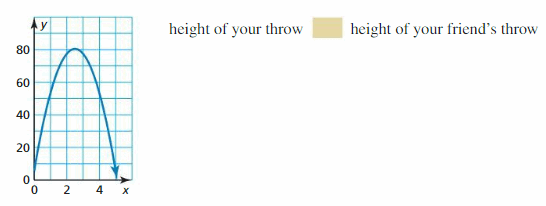
Yous and your friend are throwing a football. The parabola shows the path of your friend's throw, where x is the horizontal distance (in feet) and y is the respective height (in feet). The path of your throw tin can be modeled past h(x) = −16xii + 65x + 5. Cull the correct inequality symbol to indicate whose throw travels higher. Explain your reasoning.
Question 2.
The function g(x) = \(\frac{1}{2}\)∣ten − 4 ∣ + iv is a combination of transformations of f(ten) = | ten|. Which combinations describe the transformation from the graph of f to the graph of yard?
A. translation four units right and vertical compress by a factor of \(\frac{ane}{2}\), followed past a translation 4 units up
B. translation iv units right and 4 units up, followed by a vertical compress by a factor of \(\frac{ane}{2}\)
C. vertical shrink past a cistron of \(\frac{one}{ii}\) , followed past a translation 4 units up and iv units right
D. translation four units right and 8 units up, followed by a vertical shrink by a factor of \(\frac{1}{ii}\)
Question 3.
Your school decides to sell tickets to a dance in the school cafeteria to enhance money. There is no fee to utilise the cafeteria, but the DJ charges a fee of $750. The tabular array shows the profits (in dollars) when ten students attend the trip the light fantastic toe.
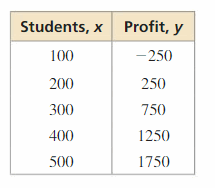
a. What is the cost of a ticket?
b. Your school expects 400 students to attend and finds another DJ who only charges $650. How much should your school accuse per ticket to however brand the same turn a profit?
c. Your schoolhouse decides to charge the amount in part (a) and utilise the less expensive DJ. How much more money will the school enhance?
Question four.
Order the following parabolas from widest to narrowest.
A. focus: (0, −iii); directrix: y = 3
B. y = \(\frac{1}{xvi}\)x2 + 4
C. x = \(\frac{1}{8}\)yii
D. y = \(\frac{ane}{4}\)(x − 2)2 + 3
Question 5.
Your friend claims that for one thousand(10) = b, where b is a real number, there is a transformation in the graph that is impossible to notice. Is your friend correct? Explain your reasoning.
Question half dozen.
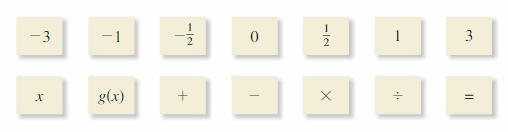
Permit the graph of g represent a vertical stretch and a reflection in the x-axis, followed by a translation left and down of the graph of f(ten) = xtwo. Use the tiles to write a rule for g.
Question 7.
Two assurance are thrown in the air. The path of the commencement ball is represented in the graph. The 2nd ball is released i.5 feet higher than the first brawl and afterward 3 seconds reaches its maximum height 5 feet lower than the kickoff ball.
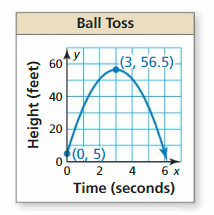
a. Write an equation for the path of the 2nd ball.
b. Exercise the assurance hit the ground at the same time? If and so, how long are the balls in the air? If not, which ball hits the ground first? Explain your reasoning.
Question 8.
Let the graph of thousand exist a translation 3 units right of the graph of f. The points (−i, 6), (3, 14), and (half dozen, 41) lie on the graph of f. Which points lie on the graph of yard?
A. (2, vi)
B. (2, 11)
C. (6, 14)
D. (6, 19)
East. (9, 41)
F. (nine, 46)
Question 9.
Gym A charges $10 per month plus an initiation fee of $100. Gym B charges $30 per month, only due to a special promotion, is not currently charging an initiation fee.
a. Write an equation for each gym modeling the full price y for a membership lasting x months.
b. When is it more economical for a person to choose Gym A over Gym B?
c. Gym A lowers its initiation fee to $25. Depict the transformation this change represents and how it affects your decision in office (b).
Source: https://bigideasmathanswer.com/big-ideas-math-algebra-2-answers-chapter-2/
0 Response to "Review for Chapter 2 Algebra 2 Big Ideas"
Enviar um comentário