My Baby Had a Stroke Because of Hole in Heart
Adjusted from "Holes in the Eye," Stroke Connection Magazine, January/February 2011
A hole in your heart would seem to be the very definition of a "problem." Yet more than than a quarter of the population has one, and for most it causes no agin health furnishings. In fact, the vast majority of those afflicted don't even know it.
At that place are two kinds of holes in the heart. One is called an atrial septal defect (ASD), and the other is a patent foramen ovale (PFO). Although both are holes in the wall of tissue (septum) between the left and correct upper chambers of the heart (atria), their causes are quite unlike. An ASD is a failure of the septal tissue to class between the atria, and as such it is considered a congenital heart defect, something that y'all are born with. By and large an ASD pigsty is larger than that of a PFO. The larger the pigsty, the more likely there are to be symptoms.
PFOs, on the other hand, can only occur subsequently birth when the foramen ovale fails to close. The foramen ovale is a pigsty in the wall between the left and correct atria of every human fetus. This pigsty allows blood to bypass the fetal lungs, which cannot work until they are exposed to air. When a newborn enters the world and takes its first breath, the foramen ovale closes, and within a few months it has sealed completely in most 75 pct of united states. When it remains open, it is called a patent foramen ovale, patent pregnant open. For the vast majority of the millions of people with a PFO, information technology is not a problem, even though blood is leaking from the right atrium to the left. Issues can arise when that blood contains a blood clot.
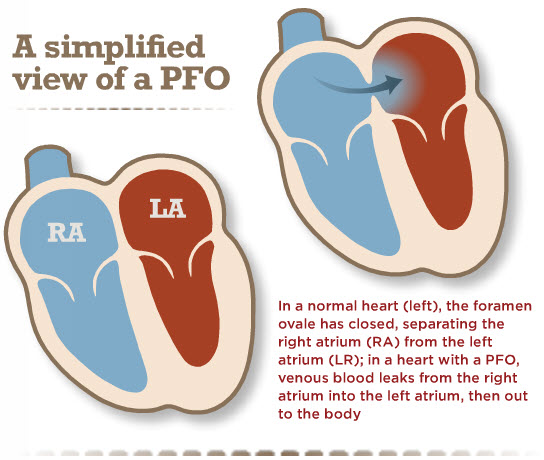
"Blood clots grade in our veins all the time," said Dr. David Thaler, associate professor of neurology at Tufts Academy Schoolhouse of Medicine and director of the Comprehensive Stroke Center at Tufts Medical Eye in Boston. "These are tiny claret clots of just a few millimeters that travel from all over the body into the vena cava where they enter the right upper chamber of the center." From there they are pumped into the right ventricle, from where they enter the lungs. These tiny claret clots (individually called a venous thrombus) go filtered by the tiny capillaries in the lungs, after which the freshly oxygenated blood enters the left atrium, then the left ventricle. From the left ventricle, the blood is pumped out into the miles of blood vessels that feed oxygen and nutrients to every jail cell in our bodies. "Our lungs ordinarily filter out these tiny clots, but a 2mm thrombus in the brain can cause real havoc," Dr. Thaler said.
That can happen when someone has a PFO or ASD. "PFOs don't actually cause strokes, but they provide a portal through which a thrombus might pass from the right to the left side of the apportionment," said Dr. Patrick O'Gara, professor of medicine at Harvard Medical Schoolhouse and executive director of the Shapiro Cardiovascular Heart. Depending on whether the jell takes a right or left turn as information technology exits the heart, it tin can travel to the encephalon and cause stroke or TIA. Statistically speaking, the odds of this happening are depression, but it can happen.
How would you know?
Finding out whether you have a PFO is non easy, and it's something that isn't usually investigated unless a patient is having symptoms like severe migraines, TIA or stroke. Although the prevalence of PFO is about 25 percent in the general population, this increases to about forty to 50 percent in patients who have stroke of unknown crusade, referred to every bit cryptogenic stroke. This is especially true in patients who have had a stroke earlier age 55. In some cases, the PFO combines with some other condition, such as atrial fibrillation, to increase the risk of stroke.
For survivors who don't have a definitive cause of their stroke, Dr. O'Gara suggests meeting with their neurologist to talk over the possibility of PFO. "In that location are many causes of stroke and having a PFO accounts for but a very small number," Dr. O'Gara said. PFO is diagnosed with an echocardiogram. An echocardiogram, also called a cardiac echo, creates an image of the centre using ultrasound.
What'southward to be washed?
"The greatest myth most PFOs is that they must exist closed. The vast bulk of them require no treatment," Dr. O'Gara said. "If someone has one that is related to symptoms, they can exist treated with aspirin, warfarin or catheter closure, depending on the circumstances."
Of grade, drugs don't close the pigsty, "so the aim of drug treatment is to forbid a clot from forming in the first place," Dr. Thaler said. Nothing will shut it except open-eye surgery or a closure device placed by a catheter threaded from the groin through the veins to the heart. Until recently, at that place were no approved catheter-closure devices designed for PFOs. The FDA has approved a device for patients who've had a stroke believed to be caused by a PFO, which reduces the risk of another stroke.
Source: https://www.heart.org/en/health-topics/congenital-heart-defects/about-congenital-heart-defects/patent-foramen-ovale-pfo
0 Response to "My Baby Had a Stroke Because of Hole in Heart"
Enviar um comentário